
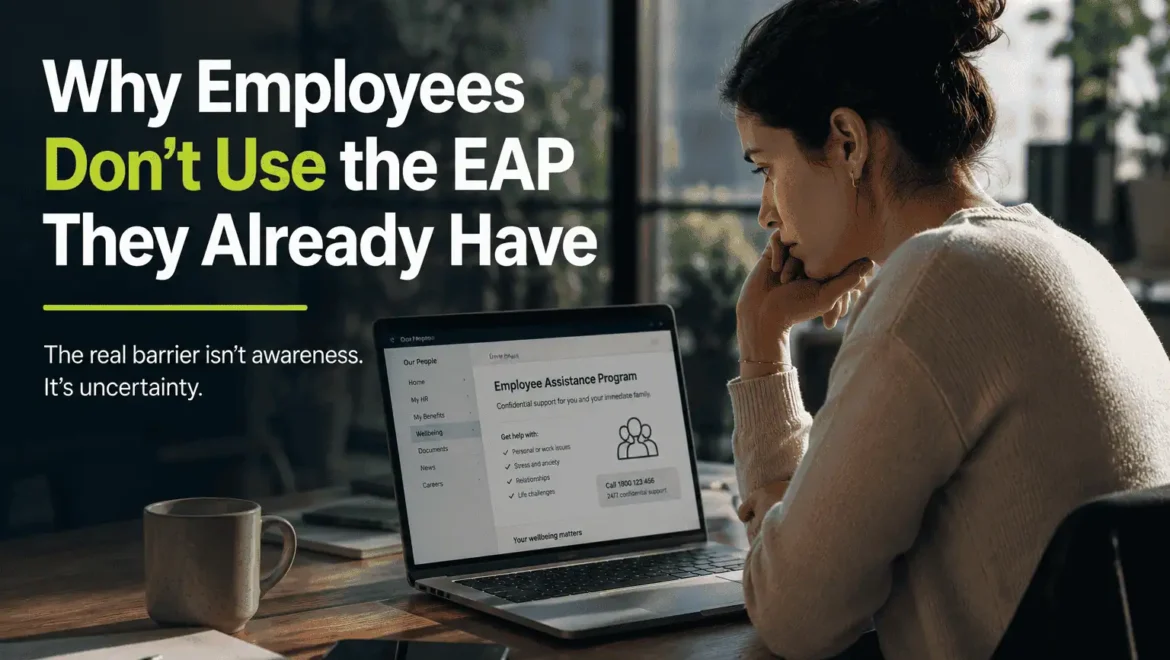
Why Employees Don’t Use the EAP They Already Have
Every Australian workplace with an EAP ticks the same box: it’s funded, it’s renewed, and it barely gets touched. The real problem isn’t the budget, it’s that almost no one has explained what actually happens after the call is made, and that silence is what’s costing organisations the early support that actually works.
Most companies don’t have an EAP problem. They have an explaining problem.
The Employee Assistance Program is funded. Renewed every year without a second thought. Nobody questions the invoice. And in most workplaces, almost nobody calls.
Not because people don’t need it. Because uncertainty feels riskier than silence.
The gap was never access
Walk into most organisations and the EAP is already there. A number on the intranet. A line in the onboarding pack. Technically available to everyone, used by almost no one.
Leaders read this as disinterest. It isn’t. It’s hesitation, and hesitation has a very specific shape.
Is it really confidential? Will someone find out? Will this come up later, in a review, in a hallway conversation, in a way I can’t take back?
Nobody wants to be the test case for a system they don’t fully trust. So people wait. They wait until the missed deadline becomes a pattern, until the quiet meeting becomes a resignation letter, until the problem is too big to manage quietly. Only then does the number get called, if it gets called at all.
This is the real cost of an unexplained EAP. Not a wasted budget. Delayed intervention, at the exact moment early support would have mattered most.
Why explaining beats promoting
The instinct when usage is low is to promote harder. A poster in the lunchroom. A line in the newsletter. A reminder in all-hands.
None of it moves the number, because the barrier was never a lack of awareness of the service. Many employees know an EAP exists. Far fewer know what actually happens when they use it.
That’s a different kind of gap, and it doesn’t close with visibility. It closes with specifics:
What “confidential” actually means in practice, including its limits.
Whether a manager is told anything, and if so, what exactly.
Whether using it can affect how someone is perceived at review time.
What the first conversation is actually like, step by step.
Organisations that get real use out of their EAP usually aren’t spending more. They’re the ones where someone, often a manager, took the time to answer these questions before anyone had to ask.
What this means for leaders
This isn’t an HR communications task. It sits with the people closest to the employee, because trust in a support system is built person to person, not policy to policy.
A manager who can answer “what actually happens if I call” in one sentence removes more hesitation than a dozen wellbeing emails. A manager who can’t, however well-intentioned, leaves the uncertainty exactly where it was.
That’s a capability gap, not a caring gap. Most managers were never trained to explain confidentiality, only to point at the poster.
What to actually do
Name the specifics, not the service. Reminding people that the EAP exists isn’t enough. Start explaining what confidential means where you work, in plain terms, more than once.
Equip managers with one sentence, not a policy document. Something they can say without hesitation: “If you use it, I’m not told what was discussed, only that you used it if you choose to tell me.” Precision beats reassurance.
Normalise it before it’s needed. The workplaces with real usage mention support in ordinary moments, not just crisis ones. During onboarding. During a rough project. Not only after something’s gone wrong.
Separate performance conversations from support conversations, visibly. If people can’t see the line between the two, they’ll assume there isn’t one, and they’ll act accordingly.
Ask people what stopped them, not whether they know it exists. Usage surveys tend to ask the wrong question. “Did you know about the EAP” almost always returns yes. “What would need to be true for you to actually use it” returns the real answer.
The real question
If someone on your team needed this today, would they know exactly what happens the moment they pick up the phone?
Most leaders assume the answer is yes. Most employees would say no.
That gap, not the invoice, is what determines whether a fully funded service ever gets used.
This is the exact capability WMHI’s Mental Health Training for Managers builds. Not a script to memorise, but the confidence to answer that question the moment it’s asked.