
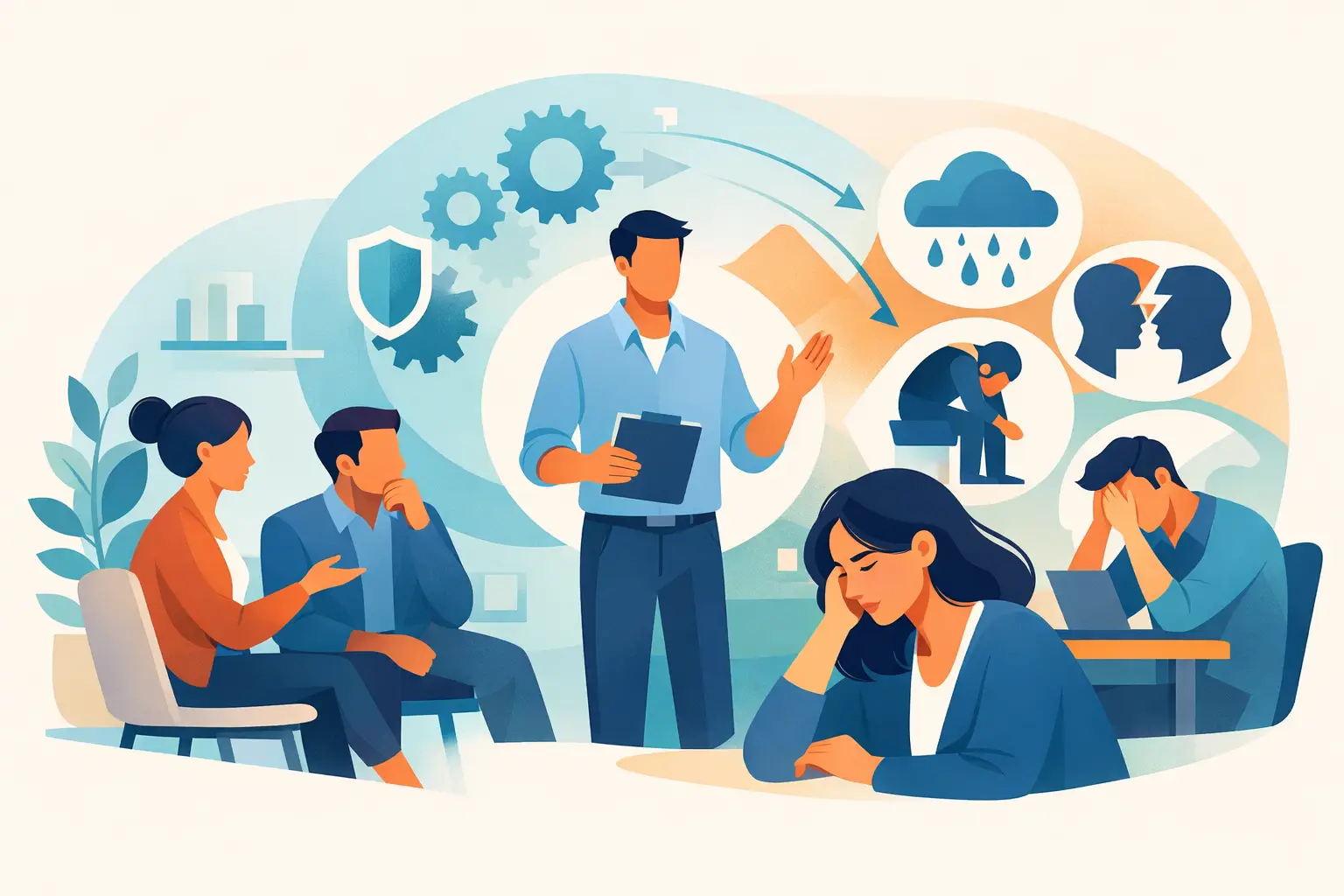
A spike in sick leave, a run of resignations, a manager who is technically strong but losing the team – these are rarely isolated people issues. More often, they are signs that psychosocial risks are already affecting performance, culture and compliance. Psychosocial hazard management training gives organisations a practical way to identify those risks early, reduce harm and build stronger day-to-day leadership capability.
For Australian employers, this is no longer a nice-to-have workshop added to a wellbeing calendar. It sits squarely within work health and safety obligations, and the cost of getting it wrong shows up fast in absenteeism, turnover, workers compensation claims, conflict and lost productivity. The strongest organisations are treating psychosocial risk the same way they treat any other operational risk – with clear ownership, capability building and measurable controls.
What psychosocial hazard management training should actually cover
Good training goes well beyond awareness. It should help leaders, HR teams and WHS professionals recognise how work design, systems and behaviours can create psychological harm. That includes common hazards such as high job demands, low role clarity, poor support, exposure to traumatic content, bullying, aggression, remote or isolated work, poor change management and inadequate reward and recognition.
Just as importantly, effective psychosocial hazard management training teaches people what to do next. That means understanding how to identify hazards, assess risk, consult meaningfully, implement controls and review whether those controls are working. If participants leave with a better vocabulary but no decision-making framework, the organisation has paid for insight without getting risk reduction.
The best programs also separate clinical issues from workplace factors. That distinction matters. Employers are not expected to diagnose personal mental health conditions, but they are expected to identify and manage hazards arising from work. Training should make that line clear so managers feel confident acting within their role rather than avoiding the issue altogether.
Why this training matters to business performance
Psychological safety and psychosocial risk management are often discussed as culture issues. They are also hard business issues. When psychosocial hazards are unmanaged, people make more errors, customer service drops, team conflict rises and discretionary effort falls. Managers spend more time dealing with reactivity and less time leading performance.
There is also a direct financial case. Psychological injury claims are often more complex, more expensive and longer in duration than many physical injury claims. Add replacement costs, productivity drag, presenteeism and reputational impact, and the commercial case becomes very clear. Training does not eliminate every risk, but it significantly improves an organisation’s ability to prevent foreseeable harm and respond before problems escalate.
This is where many businesses get caught. They have policies, an employee assistance program and a general commitment to wellbeing, but line managers are still unsure how to identify harmful work patterns, how to have early conversations or how to escalate issues properly. Training closes that capability gap. It turns broad intent into repeatable management practice.
Who needs psychosocial hazard management training
The short answer is not everyone needs the same version. Executives need to understand governance, due diligence and how psychosocial risk connects to enterprise risk, strategy and culture. HR and people and culture teams need stronger capability in consultation, investigations, return to work interfaces and organisational risk controls. WHS professionals need a shared language that integrates psychosocial hazards into existing safety systems rather than treating them as a separate stream.
Frontline managers are often the most important audience. They shape workloads, role clarity, support, feedback, team norms and the quality of change communication. In many organisations, manager capability is the difference between a psychosocial risk framework that exists on paper and one that actually influences the employee experience.
High-risk sectors may also need more tailored content. Government, defence, healthcare, community services, education, emergency-facing roles and customer aggression environments all face different exposure patterns. The training should reflect the real pressures of the workplace rather than relying on generic case studies that do not match operational reality.
What effective psychosocial hazard management training looks like
A strong program is practical, scenario-based and tied to the organisation’s real risk profile. It should use examples that reflect genuine operational pressures such as understaffing, change fatigue, difficult clients, competing priorities and poor systems. That makes the content credible for busy leaders who are accountable for delivery targets as well as team wellbeing.
It should also be interactive. People learn psychosocial risk management by applying judgment, not by memorising definitions. Workshops, masterclasses and facilitated discussions tend to produce better outcomes than passive awareness sessions because participants can test how they would respond in real situations.
Another marker of quality is whether the training fits within a broader system. On its own, training can improve knowledge and confidence. But if reporting pathways are unclear, consultation is weak or there is no process for reviewing controls, the impact will plateau. Training works best when it supports a wider approach that may include psychosocial risk assessments, leadership standards, manager tools, policy updates and targeted interventions for higher-risk teams.
Common mistakes organisations make
One of the biggest mistakes is treating psychosocial risk as a personal resilience issue only. Resilience matters, but it cannot compensate for chronically poor work design, unrealistic demands or unsafe leadership behaviour. Asking employees to be more resilient while leaving harmful systems untouched usually damages trust.
Another common mistake is overcomplicating the issue. Some organisations become stuck because they assume psychosocial hazards require a completely different language, framework and ownership model from other WHS risks. In practice, the fundamentals are familiar: identify hazards, assess risks, consult workers, implement controls and review effectiveness. The difference is in the content, not the logic.
A third mistake is relying on one-off awareness sessions. Awareness can be a starting point, but it rarely changes behaviour on its own. Managers need practice, reinforcement and tools they can use in the flow of work. That might include check-in guides, workload review questions, escalation pathways and decision aids for common scenarios.
How to choose the right psychosocial hazard management training
Start with your risk profile, not with a course catalogue. If your organisation is dealing with burnout, role overload and change fatigue, the training should build capability in work design, prioritisation, consultation and leadership communication. If the greater risk is trauma exposure or occupational violence, the content needs to address those realities more directly.
Next, look closely at the facilitator capability. This topic sits at the intersection of mental health, leadership and safety. Providers should be able to translate evidence into practical action for business leaders, not just explain theory. The strongest training partners combine subject matter expertise with operational understanding and can speak credibly to compliance, performance and culture at the same time.
It also pays to ask how success will be measured. Immediate participant feedback has value, but it is not enough. Better indicators include manager confidence, changes in reporting and consultation quality, reduction in hotspot risks, improvement in team climate data, and lower rates of psychosocial injury drivers such as conflict, unreasonable job demands or poor support.
From training to measurable change
Training is most valuable when it shifts what leaders do on Monday morning. That may mean managers start setting clearer priorities, checking workload assumptions before assigning more work, documenting concerns earlier or escalating patterns that previously went unnoticed. Small behaviour changes at scale can materially reduce risk.
For larger organisations, the next step is often embedding psychosocial risk into existing systems. That can include safety committees, incident reviews, leadership development, onboarding, change management and regular risk reviews. When psychosocial risk management becomes part of business rhythm, it stops being treated as a special topic and starts being managed properly.
This is also where external expertise can accelerate progress. A specialist provider such as Workplace Mental Health Institute can help organisations tailor training to their workforce, align programs with WHS obligations and link learning to broader cultural and performance outcomes. That matters when the goal is not simply compliance, but a healthier, more capable and more productive workplace.
The organisations doing this well are not waiting for a claim, complaint or crisis to force action. They are building manager capability early, strengthening psychological safety and treating psychosocial risk management as part of good leadership. That approach protects people, but it also protects performance – and in a demanding labour market, that is a serious advantage.