
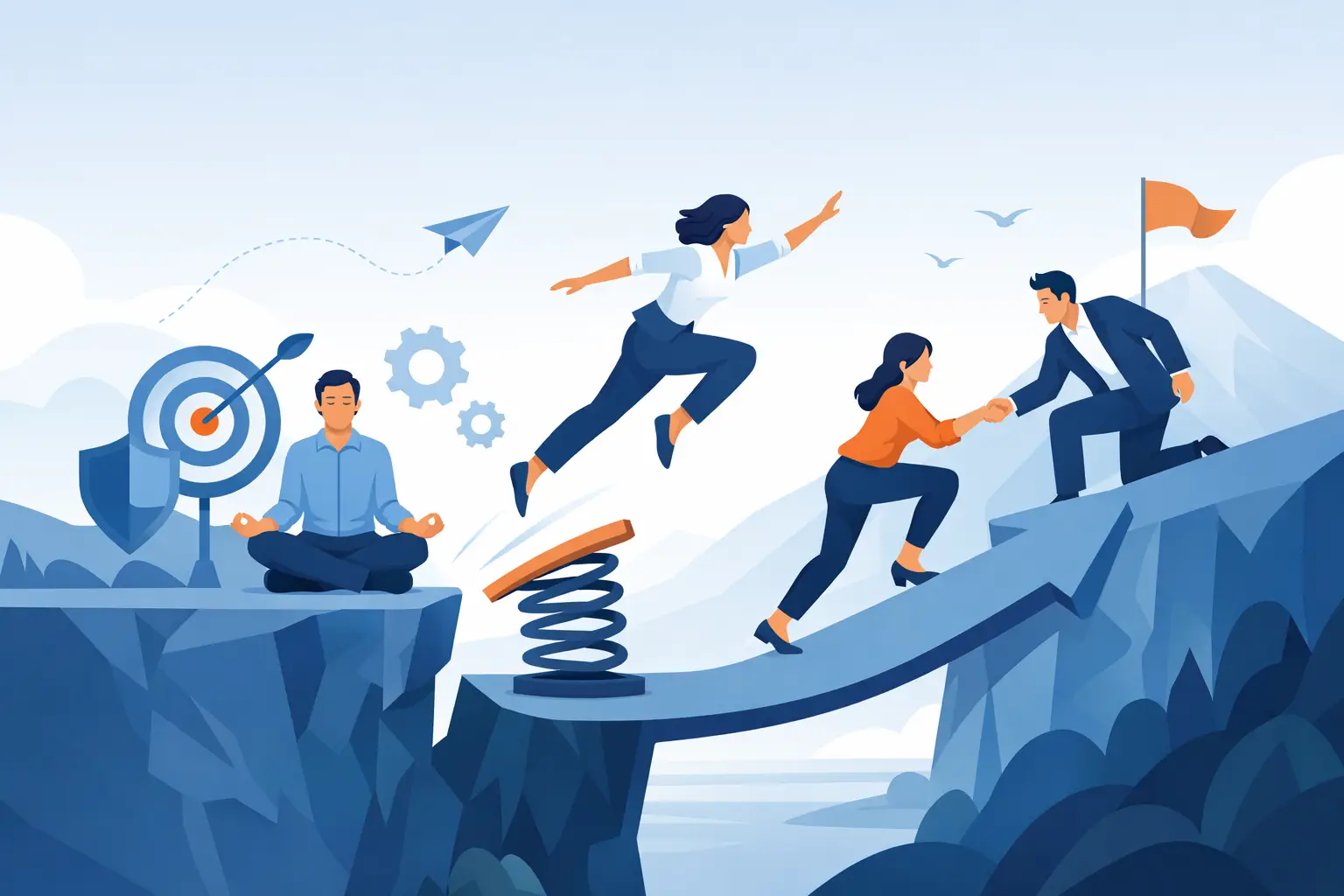
Pressure rarely announces itself politely at work. It shows up as rising sick leave, tense team dynamics, slower decision-making, more conflict, and managers who are quietly running on empty. That is why resilience training for employees has shifted from a nice-to-have wellbeing extra to a serious business capability. For Australian organisations facing burnout, psychosocial hazards and growing performance pressure, the real question is not whether resilience matters. It is whether your people are being taught the skills to sustain it.
What resilience training for employees should actually do
Too many programs treat resilience as a personality trait. Either people have it or they do not. That framing is not only inaccurate, it is operationally unhelpful. In a workplace context, resilience is better understood as a set of skills, habits and supports that help people respond well to pressure, recover from setbacks and continue performing without tipping into chronic strain.
Good training does not tell employees to simply toughen up. It helps them recognise early stress signals, regulate their response, stay effective under pressure and use support pathways appropriately. It also helps leaders understand their role in creating the conditions where resilience can grow. That matters because no amount of individual coping skill can compensate for a poorly managed workload, unclear expectations or psychologically unsafe behaviour.
This is where many organisations get the balance wrong. They invest in employee education but ignore job design, leadership capability and psychosocial risk. The strongest results come when resilience training sits alongside broader prevention work, not in place of it.
Why businesses are investing now
For HR, WHS and executive teams, resilience is not just a wellbeing issue. It is a risk, performance and retention issue. When pressure is unmanaged, the costs show up quickly in absenteeism, presenteeism, turnover, disengagement and psychological injury claims. Teams become reactive. Managers spend more time dealing with interpersonal friction. Productivity drops, even when headcount stays the same.
Resilience training can help reduce those pressures, but only if it is designed for workplace reality. A generic session on positive thinking will not move the needle. Employees need practical tools they can apply during a difficult client conversation, after a critical incident, in a high-change environment or when workloads spike for weeks rather than days.
From a commercial perspective, the value is straightforward. Employees who can regulate stress, maintain perspective and recover more effectively are more likely to stay engaged, make sound decisions and contribute consistently. From a legal and governance perspective, capability-building also supports an employer’s broader approach to psychosocial safety, particularly when paired with leadership training and hazard management.
What effective resilience training looks like
The best programs are practical, evidence-based and tied to real work scenarios. They teach people how stress works in the body and mind, but they do not stop at awareness. They build capability.
That usually includes skills such as emotional regulation, attention management, adaptive thinking, boundary-setting, recovery strategies and help-seeking confidence. In stronger programs, participants also learn how to identify when a challenge is within their influence, when it needs escalation, and how to stay effective during uncertainty rather than getting stuck in rumination or overload.
Context matters here. A frontline healthcare team, a construction workforce, a government department and a fast-growth professional services firm will not experience pressure in the same way. Their training should not be identical either. The examples, scenarios and language need to match operational reality, or the learning stays theoretical.
Delivery style matters too. One-off awareness sessions can create a useful starting point, but behaviour change usually requires reinforcement. Workshops, manager-led follow-up, short digital refreshers and practical tools embedded into day-to-day routines tend to produce stronger uptake than a single event people forget within a fortnight.
The role of managers in employee resilience
Resilience is often discussed as an employee issue, but managers influence it every day. They shape workload clarity, role expectations, feedback quality, conflict resolution and team norms around speaking up. A capable manager can reduce pressure before it escalates. An unskilled one can intensify it, even with good intentions.
That is why training employees without training managers is a common weak point. If staff are taught to regulate stress but leaders continue to reward overwork, avoid difficult conversations or create ambiguity, the training impact will be limited.
Manager capability should include recognising strain, having confident mental health conversations, responding early to issues, and supporting psychologically safe team practices. This is not about turning managers into clinicians. It is about equipping them to lead in a way that protects performance and reduces preventable harm.
For many organisations, this is the turning point. Once resilience is treated as part of leadership effectiveness rather than a standalone wellbeing topic, implementation becomes far more credible.
Common mistakes that undermine results
The first mistake is using resilience training as a substitute for fixing harmful work conditions. If workloads are unreasonable, change is chaotic or bullying behaviours are unchecked, employees will see the program for what it is – a message to cope better with a broken system. That damages trust.
The second is making the content too broad. Staff do not need vague encouragement to be more positive. They need simple, credible tools for managing pressure, recovering energy and responding to setbacks without losing effectiveness.
The third is failing to measure impact. If the only success metric is attendance, you are missing the point. Organisations should look at changes in confidence, behaviour, manager capability, psychological safety indicators, absence trends and engagement data over time. It will never be a pure cause-and-effect equation, but measurable improvement should still be part of the brief.
Another mistake is assuming everyone needs the same intervention. Some teams need foundational resilience skills. Others need manager coaching, better workload systems or support after a critical incident. A mature approach starts with diagnosis, not assumptions.
How to choose the right resilience training for employees
Start with your risk profile and operational goals. Are you trying to reduce burnout in a high-demand team, support leaders through change, improve psychosocial safety capability, or strengthen recovery after repeated exposure to distressing work? The answer shapes the design.
Then look closely at credibility. Who is delivering the training, and what expertise do they bring? In this space, qualifications and real workplace experience matter. Employees and leaders are more likely to engage when the content is grounded in behavioural science, mental health expertise and organisational reality, not generic motivation.
You should also test for practicality. Will participants leave with tools they can use that week? Will managers know what to do differently in team meetings, one-on-ones and workload planning? Can the program scale across sites, functions or countries without losing relevance?
Finally, ask how the training fits into your broader strategy. The strongest providers do not treat resilience as an isolated workshop. They connect it to leadership, psychosocial hazard management, mental health literacy and culture. That integrated approach is where organisations tend to see more durable gains.
Where resilience training delivers the most value
Resilience training tends to have the strongest impact in environments where pressure is real, ongoing and difficult to remove entirely. That includes high-change businesses, people-facing sectors, trauma-exposed roles, fast-growth teams and operational settings where mistakes carry meaningful consequences.
Even then, outcomes vary. If your culture already supports reasonable workloads, strong leadership and early intervention, training can sharpen capability and improve consistency. If your culture is fragmented or trust is low, training may still help, but it needs to be part of a broader reset.
This is the trade-off leaders need to understand. Resilience training is highly valuable, but it is not magic. It works best when the organisation is also willing to examine what is driving pressure in the first place.
For that reason, many employers are moving towards a more mature model: build individual skills, strengthen manager capability, and address psychosocial hazards at the systems level. Providers such as Workplace Mental Health Institute focus on that practical intersection because it is where resilience stops being a slogan and starts improving how people work.
If your workforce is tired, stretched or carrying more pressure than is sustainable, the answer is not to ask for more grit. It is to build the skills, leadership and workplace conditions that make steady performance possible under pressure.