
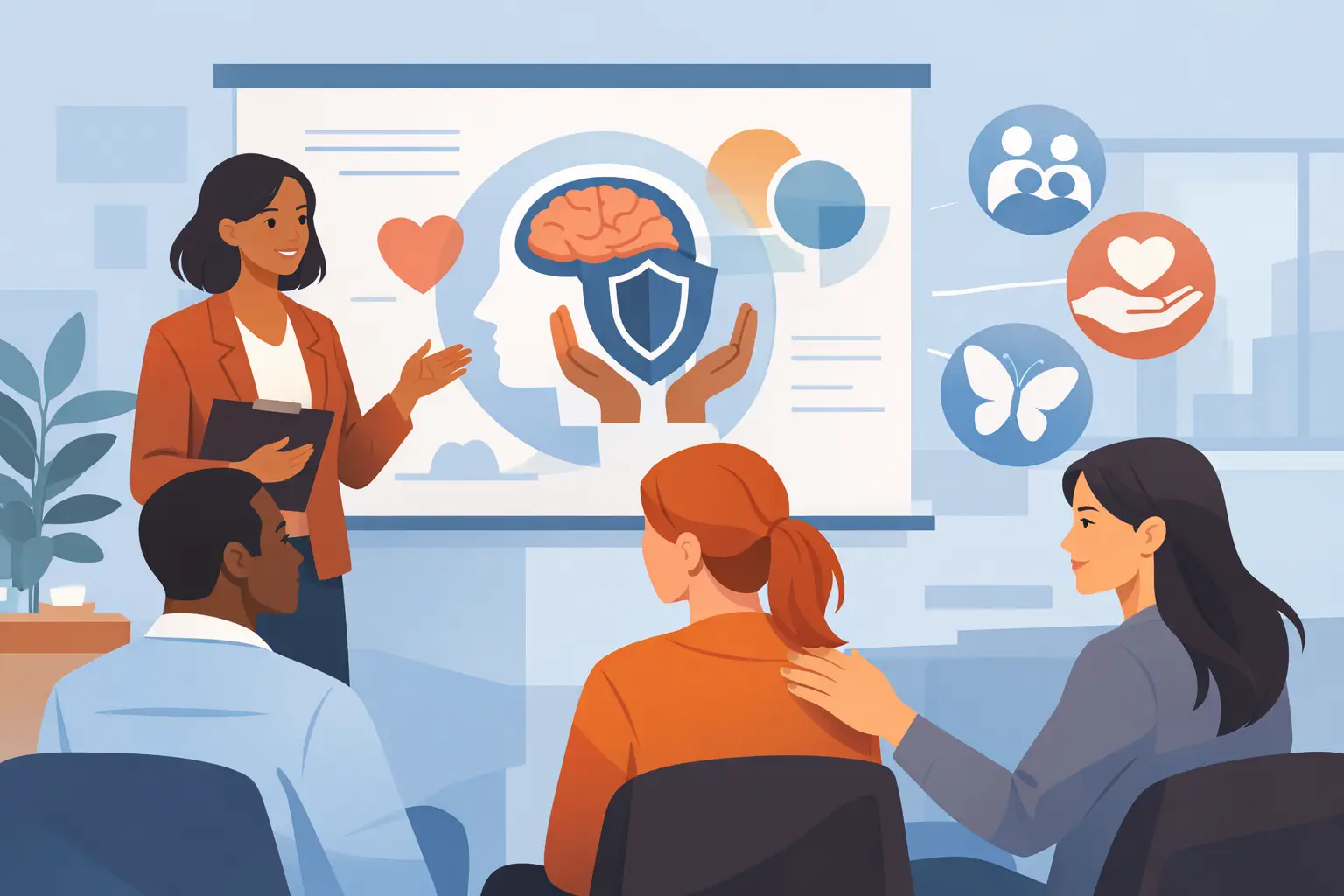
A manager notices a high performer has gone quiet in meetings, is missing deadlines, and reacts sharply to routine feedback. In many workplaces, that gets labelled as a performance issue first and a human issue second. That is exactly where trauma informed care training workplace programs change the conversation. They help leaders respond with clarity, boundaries and skill, instead of assumption, avoidance or overreach.
For employers, this is not about turning managers into therapists. It is about building a psychologically safer workplace where people leaders understand how trauma can affect behaviour, communication, concentration, trust and regulation at work. Done well, this kind of training strengthens performance, reduces risk and gives teams a more consistent way to respond when people are under pressure.
Why trauma informed care matters at work
Trauma is not rare, and it does not stay neatly outside business hours. Employees may be living with the effects of family violence, grief, accidents, discrimination, bullying, moral injury, community crises or exposure to distressing material through their role. Some workplaces also carry direct operational risk, particularly in sectors such as healthcare, community services, emergency response, defence, education and customer-facing environments.
The workplace impact is often misunderstood. Leaders may see withdrawal, irritability, hypervigilance, absenteeism, conflict or sudden drops in output without understanding what is driving them. That does not mean every behavioural change is trauma-related. It does mean organisations need a more informed framework for responding to distress and dysregulation without escalating harm.
There is also a clear business case. Teams with stronger psychological safety tend to report better engagement, better speaking-up cultures and lower avoidable conflict. From a WHS and psychosocial hazard perspective, employers are also under growing pressure to identify risks, respond reasonably and equip leaders to act early. Trauma-informed capability supports that broader duty. It can reduce the chance that a well-meaning but poorly handled conversation becomes a bigger cultural, legal or health issue.
What trauma informed care training workplace programs actually cover
A credible program should be practical, role-relevant and grounded in workplace realities. Awareness on its own is not enough. Leaders need to know what to do, what not to do, and where their responsibilities begin and end.
Most effective training covers the signs that someone may be under significant stress, the ways trauma can affect attention, memory, behaviour and communication, and the importance of predictability, choice, respect and emotional safety. It should also address common leadership moments such as giving feedback, managing conflict, supporting return to work, handling disclosures and responding after a critical incident.
Crucially, good training reinforces boundaries. Managers should not investigate personal histories, push for disclosure or try to counsel staff. Their role is to notice, respond appropriately, reduce unnecessary triggers where possible, and connect people with the right supports. That distinction matters. Without it, organisations can create liability while exhausting leaders who are already carrying significant people responsibilities.
For frontline teams, the focus may be slightly different. Employees often need skills in respectful communication, de-escalation, peer support boundaries and recognising when workplace processes may unintentionally re-trigger distress. Senior leaders, meanwhile, need to understand the organisational settings that either support recovery and stability or compound harm.
The operational benefits are broader than wellbeing
One of the common mistakes in this space is treating trauma-informed training as a wellbeing extra. In practice, it sits much closer to leadership capability, risk management and culture performance.
When managers know how to create calmer, clearer interactions, performance conversations improve. Expectations can still be firm, but they are less likely to be delivered in ways that trigger defensiveness or shutdown. Teams also become more consistent in how they handle distress, conflict and critical incidents. That consistency protects culture.
There are risk reduction benefits too. Poorly managed responses to trauma can contribute to grievances, psychological injury claims, prolonged absence and turnover. They can also damage trust in leadership. Training does not eliminate those risks, but it can lower them by improving early response, documentation practices, referral confidence and day-to-day communication.
This is especially relevant for organisations working to strengthen psychosocial safety. A trauma-informed lens helps employers examine whether ordinary systems such as rostering, workload allocation, incident reviews, complaints handling and disciplinary processes are being delivered in a way that is fair, predictable and respectful. Sometimes the issue is not a lack of care. It is a lack of structure.
What good implementation looks like
The most effective organisations do not stop at a single workshop. They treat trauma-informed capability as part of a broader workplace mental health and psychosocial safety strategy.
That usually starts with identifying where exposure and risk are highest. In some businesses, that will be customer aggression, vicarious trauma or repeated exposure to distressing content. In others, the issue may be poor manager confidence, inconsistent leadership behaviour or a recent critical incident that exposed capability gaps. The training design should match those realities rather than applying a generic mental health session across the board.
Managers should receive scenario-based training that reflects real conversations they are likely to face. Generic theory rarely changes behaviour under pressure. Leaders need practice in how to ask supportive questions, how to maintain performance expectations, how to pause an escalating discussion, and how to refer without sounding clinical or detached.
It also helps to align training with policy, reporting pathways and support systems. If leaders are taught to respond early but do not know where to send someone, the organisation has only solved half the problem. Likewise, if employees are encouraged to speak up but fear inconsistent treatment, training will not shift culture on its own.
Measurement matters here. Organisations should look at manager confidence, employee perceptions of psychological safety, absenteeism trends, incident data, turnover in high-exposure teams and the quality of post-incident responses. The point is not to force a simplistic ROI figure onto a complex issue. It is to make sure capability-building translates into operational improvement.
Common mistakes that weaken outcomes
Some organisations overcorrect and make everything trauma-related. That creates confusion, lowers accountability and can make leaders hesitant to address legitimate performance issues. A trauma-informed approach is not a no-standards approach. It simply means using a safer, more informed way to hold those standards.
Others keep the training too soft. If the session is all empathy and no application, managers leave with good intentions but little behavioural change. The workplace test is practical: can leaders run difficult conversations better, spot risk earlier and use appropriate support pathways with confidence?
Another common issue is ignoring manager load. Leaders cannot be expected to absorb complex people risk without support themselves. If they are carrying excessive workloads, receiving little supervision and dealing with repeated distressing situations, training alone will not protect them. Organisational design still matters.
There is also an implementation trap in assuming one audience needs the same content as another. Executives need governance and risk insight. Managers need conversation skills. Teams need shared language and respectful behaviours. High-exposure roles may need more advanced content around cumulative stress, boundaries and recovery. Tailoring improves relevance and uptake.
How to choose the right training partner
Not all providers approach trauma-informed work with the same level of rigour. For employers, credibility matters. The training should be led by professionals with genuine mental health expertise, strong facilitation capability and a clear understanding of workplace systems, not just clinical concepts.
Ask whether the program is designed for organisational settings rather than community care environments. The principles overlap, but workplaces need training that speaks to performance, psychosocial hazards, leadership accountability and legal context. It should be evidence-based, commercially realistic and suitable for your sector.
Look for practical delivery. Strong programs use case studies, discussion, role play and implementation tools rather than relying on awareness slides. They should also be clear about limits, including what managers are not expected to do. That protects both employees and leaders.
For larger or multinational employers, consistency across regions can matter just as much as local relevance. A scalable training model with adaptable examples, digital options and leadership reinforcement often delivers better long-term value than a one-off event.
Workplace Mental Health Institute, for example, approaches this space through practical, specialist-led training that connects trauma-informed practice with psychological safety, leadership capability and measurable workplace outcomes.
Trauma informed care training workplace strategy is now a leadership issue
There was a time when trauma-informed practice sat mostly in health and community services. That is no longer the case. As organisations face rising psychosocial risk, more complex employee needs and sharper expectations on leadership behaviour, trauma informed care training workplace capability has become a business issue as much as a care issue.
The organisations doing this well are not lowering standards or becoming overly clinical. They are building managers who can lead with steadiness, respond without causing further harm and maintain performance in a way people can actually hear. That is good for culture, good for risk management and good for results.
If your leaders are already having these conversations, the question is not whether trauma affects your workplace. It is whether your people have the capability to respond well when it does.