
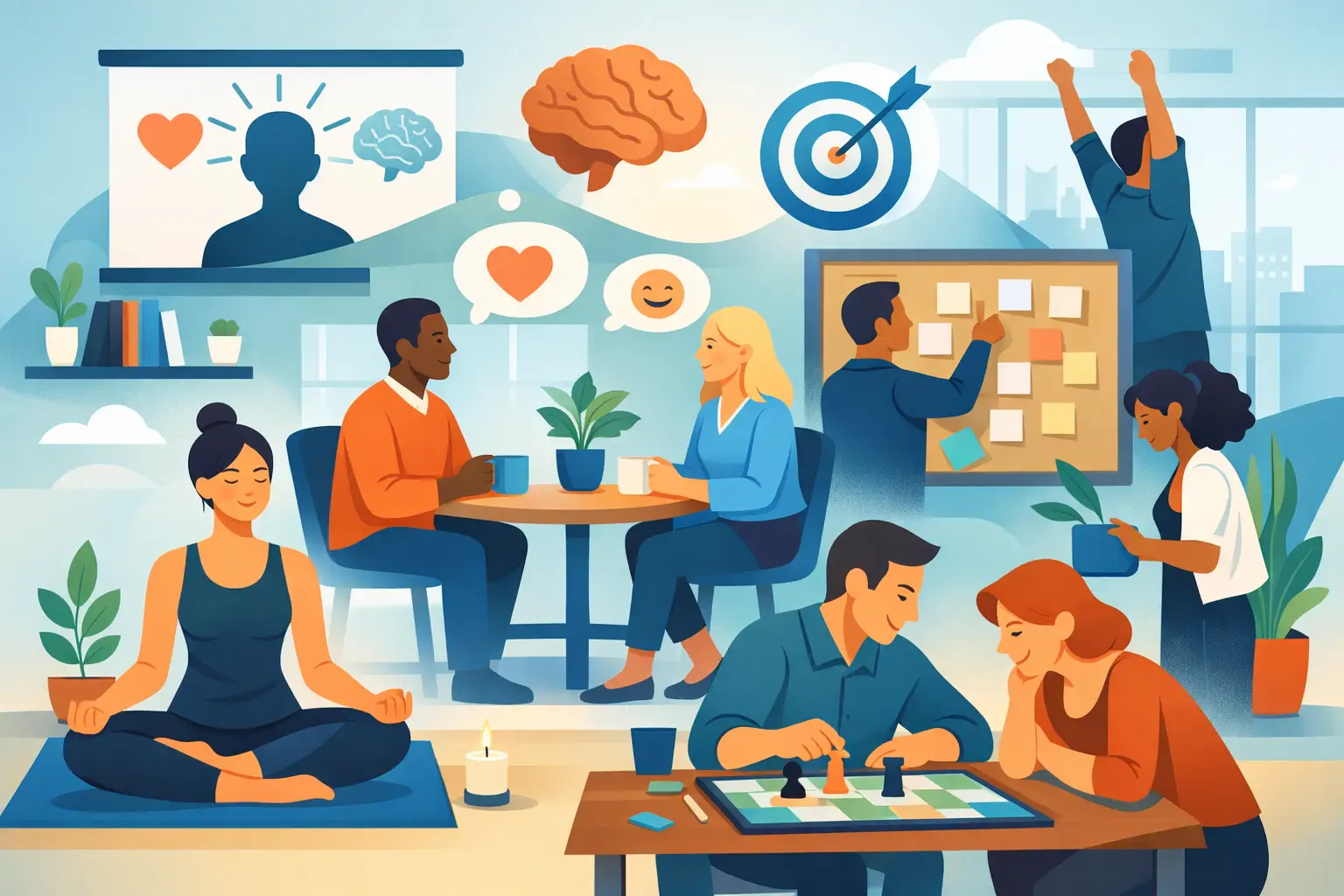
A free yoga class at lunch might get a few sign-ups. It will not, on its own, fix burnout, poor manager behaviour, rising psychological injury claims or a team culture where people stay quiet until they are overwhelmed. The most effective workplace mental health activities are not random wellbeing extras. They are practical actions tied to psychological safety, risk reduction and better day-to-day performance.
That distinction matters for HR leaders, WHS professionals and executives under pressure to do more than tick the wellbeing box. If the activity does not help people work more safely, speak up earlier, manage pressure better or lead with more confidence, it is probably not solving the real problem. Good activity design starts with business need, not good intentions.
What workplace mental health activities should actually achieve?
At organisational level, mental health activities should improve capability, not just awareness. Awareness has a role, but awareness alone rarely changes behaviour. Teams need practical skills. Managers need confidence. Leaders need visibility over psychosocial hazards. Employees need clear pathways for support, recovery and early intervention.
The best activities do at least one of four things. They reduce exposure to psychosocial risks, strengthen protective factors such as connection and role clarity, build mental health literacy with a clear workplace focus, or improve the systems leaders use to respond when someone is struggling.
This is where many workplaces get stuck. They run a calendar of wellbeing events but leave workload, job design, conflict, poor communication and inconsistent leadership untouched. That creates a credibility gap. Staff can spot the difference between a genuine mental health strategy and a collection of feel-good gestures.
10 workplace mental health activities that make a real difference
1. Manager-led check-in routines
Regular, structured check-ins are one of the most effective workplace mental health activities because they normalise early conversation. Done well, they are brief and consistent rather than informal and vague. A manager asking, “What is putting pressure on you this week?” is often more useful than a broad question about wellbeing.
The trade-off is that check-ins only work when managers are trained to listen, respond appropriately and follow through. Without capability, a check-in can feel performative or intrusive. The activity matters, but manager skill matters more.
2. Team psychosocial risk reviews
Most workplace stressors are not hidden. Teams usually know where pressure is building – unrealistic deadlines, competing priorities, unclear roles, poor change communication or difficult interpersonal dynamics. A facilitated risk review gives staff a structured way to identify hazards and discuss controls.
This is especially valuable for organisations responding to psychosocial obligations under WHS frameworks. It shifts mental health from a private issue to a shared work design issue. That is a more mature and legally defensible approach.
3. Mental health capability workshops for leaders
Leadership behaviour shapes culture faster than posters or morning teas ever will. Workshops that build practical leadership capability can improve confidence in having difficult conversations, recognising early signs of distress, setting healthy expectations and managing team pressure.
The key is to keep the training specific to the workplace. Leaders do not need to become clinicians. They need usable skills for role clarity, communication, escalation and support. When training is framed around performance and risk reduction, it tends to land better with operational leaders.
4. Peer connection activities with a clear purpose
Connection is protective, but not every social event improves connection in a meaningful way. A Friday afternoon pizza can be fine. It is not a strategy. More effective activities create psychological safety through guided discussion, cross-team problem solving or facilitated reflection after periods of high demand.
In practice, this could mean small-group conversations after a major project, a team debrief following organisational change, or peer forums where managers discuss common challenges. The purpose is to reduce isolation and strengthen trust, not just fill the calendar.
5. Workload reset sessions
If employees are overloaded, another wellbeing activity can feel like one more thing to attend. A workload reset is different. It gives teams permission to review priorities, stop low-value work, clarify decision rights and discuss what capacity actually looks like.
This activity often produces immediate gains because it targets one of the most common drivers of poor mental health at work – sustained high demand with limited control. It also sends an important message: mental health is influenced by how work is organised, not just how resilient people are expected to be.
6. Recovery and resilience micro-skills sessions
Resilience is useful when it is taught properly. That means practical techniques employees can apply in a busy workday, such as boundary setting, cognitive reframing, recovery planning, stress regulation and help-seeking. Short, skill-based sessions tend to work better than generic motivational talks.
There is a balance to strike here. Resilience training can add value, but it should never be used to shift responsibility away from the organisation. If the workplace creates chronic harm, asking people to become more resilient is not enough.
7. Critical incident and post-event debriefs
In high-pressure sectors, people may be exposed to distressing events, complaints, aggression, trauma-related content or operational incidents. Structured debriefs help teams process what happened, identify support needs and review what should change next time.
These activities are particularly relevant for frontline services, care settings, government environments and any workplace with high emotional load. Timing matters. Debriefs need to be planned and psychologically informed, not rushed or treated as a box-ticking exercise.
8. Manager office hours for early support
Some employees will not raise concerns in a formal performance meeting. Offering regular office hours gives staff a lower-pressure way to discuss workload, conflict, stress or support needs before issues escalate.
This simple activity can strengthen trust and improve early intervention, especially in larger teams. It works best where confidentiality boundaries are clear and managers know when to support directly, when to adjust work and when to escalate.
9. Wellbeing pulse checks with visible follow-through
Short pulse surveys can be useful if they measure something actionable – workload, support, role clarity, safety to speak up, fatigue or change impact. The mistake is asking for feedback and then doing nothing with it.
A pulse check becomes a mental health activity when leaders share results, explain priorities and act on the data. Even small visible changes build credibility. Silence after a survey does the opposite.
10. Team agreements on communication and boundaries
Many teams operate with unspoken rules that fuel stress: late-night messages, unclear escalation, constant interruptions or unrealistic response times. Creating team agreements on communication norms can reduce friction quickly.
This is a low-cost activity with high practical value. It helps teams define what urgent means, when people are expected to be available, how meetings are run and how workload concerns are raised. Clear expectations reduce ambiguity, and ambiguity is often a hidden source of strain.
How to choose the right workplace mental health activities
Not every activity suits every organisation. A distribution centre, a government department and a professional services firm will face different hazards, leadership pressures and workforce needs. The right choice depends on your risk profile, operating environment and current maturity.
Start with the problems showing up in your data. If absenteeism is climbing, manager confidence is low and claims are increasing, awareness events are unlikely to be enough. You may need manager training, psychosocial risk assessment and clearer response pathways. If engagement is steady but teams are fatigued after rapid growth, workload reset sessions and communication agreements may have more impact.
It is also worth looking at reach. Some activities are useful but narrow. Others shift behaviour across the system. Leadership training, risk reviews and team-based practices usually create broader change because they influence how work is experienced every day.
What makes these activities stick
The strongest mental health programs are not built around one-off events. They are reinforced through leadership, policy, manager behaviour and ongoing measurement. If employees hear one message in training but experience another in their workload, deadlines or treatment by leaders, the activity will lose credibility fast.
That is why practical implementation matters. Build activities into existing rhythms such as team meetings, manager one-to-ones, project reviews and leadership forums. Measure outcomes where you can – participation alone is not enough. Look for changes in confidence, help-seeking, role clarity, team climate, absence patterns and psychological risk indicators.
For organisations that want measurable change, the goal is not to run more activity. The goal is to run the right activity, at the right level, with the right leadership support. That is where training and consulting can move the needle from awareness to capability.
Workplace Mental Health Institute works with organisations on exactly this challenge: turning mental health from a vague wellbeing intention into practical systems, skills and leadership actions that improve safety and performance.
If your current approach feels busy but not effective, that is useful information. The next step is not another token event. It is choosing workplace mental health activities that change how work is led, how risks are managed and how people are supported when pressure rises.