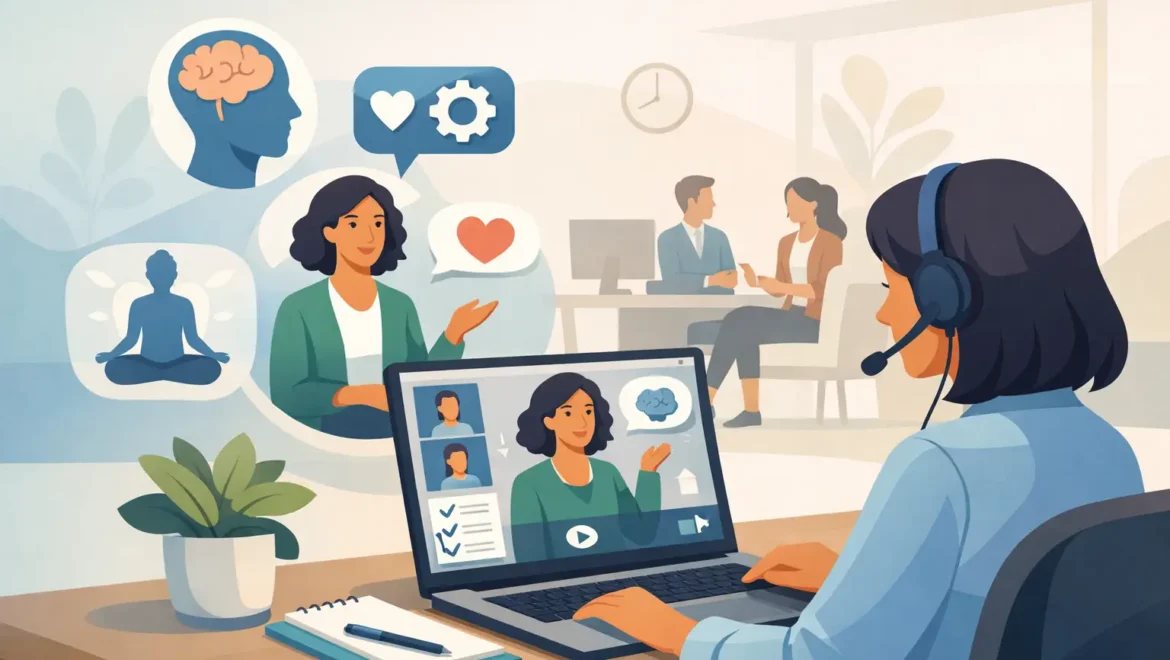
Online Mental Health Training for the Workplace
A manager notices a high performer withdrawing in team meetings, missing deadlines and taking more sick days. They want to help, but they are unsure what to say, what questions to ask, or where their responsibility starts and ends. That is where online mental health training workplace programs stop being a nice-to-have and start becoming a business capability.
For many organisations, the old approach was awareness only. A webinar during Mental Health Month, a few posters, perhaps an EAP reminder. The problem is that awareness without skill rarely changes behaviour. Leaders still avoid conversations. Teams still miss early warning signs. Risks still escalate into absenteeism, conflict, turnover and psychological injury claims. Training needs to move people from recognition to response.
Why online mental health training in the workplace matters now
Australian employers are operating in a very different risk environment than they were even a few years ago. Psychosocial hazards are now firmly on the executive agenda. Fatigue, bullying, trauma exposure, high job demands, poor support, role ambiguity and remote work pressures all affect performance as well as wellbeing. When these issues are left unmanaged, the commercial consequences are obvious. Productivity slips, leaders spend more time firefighting, and staff confidence in the organisation erodes.
Online delivery has changed what is possible. It allows organisations to build mental health capability at scale across locations, shift patterns and leadership levels. That matters for national employers, regional teams and businesses with hybrid or dispersed workforces. It also matters when consistency is a priority. Every manager should receive the same practical guidance on early intervention, supportive conversations, escalation pathways and psychologically safe leadership.
That said, online is not automatically effective. A slide deck with a quiz at the end is not a strategy. The value comes from well-designed training that is relevant to role, legally informed, behaviourally focused and easy to apply in real work settings.
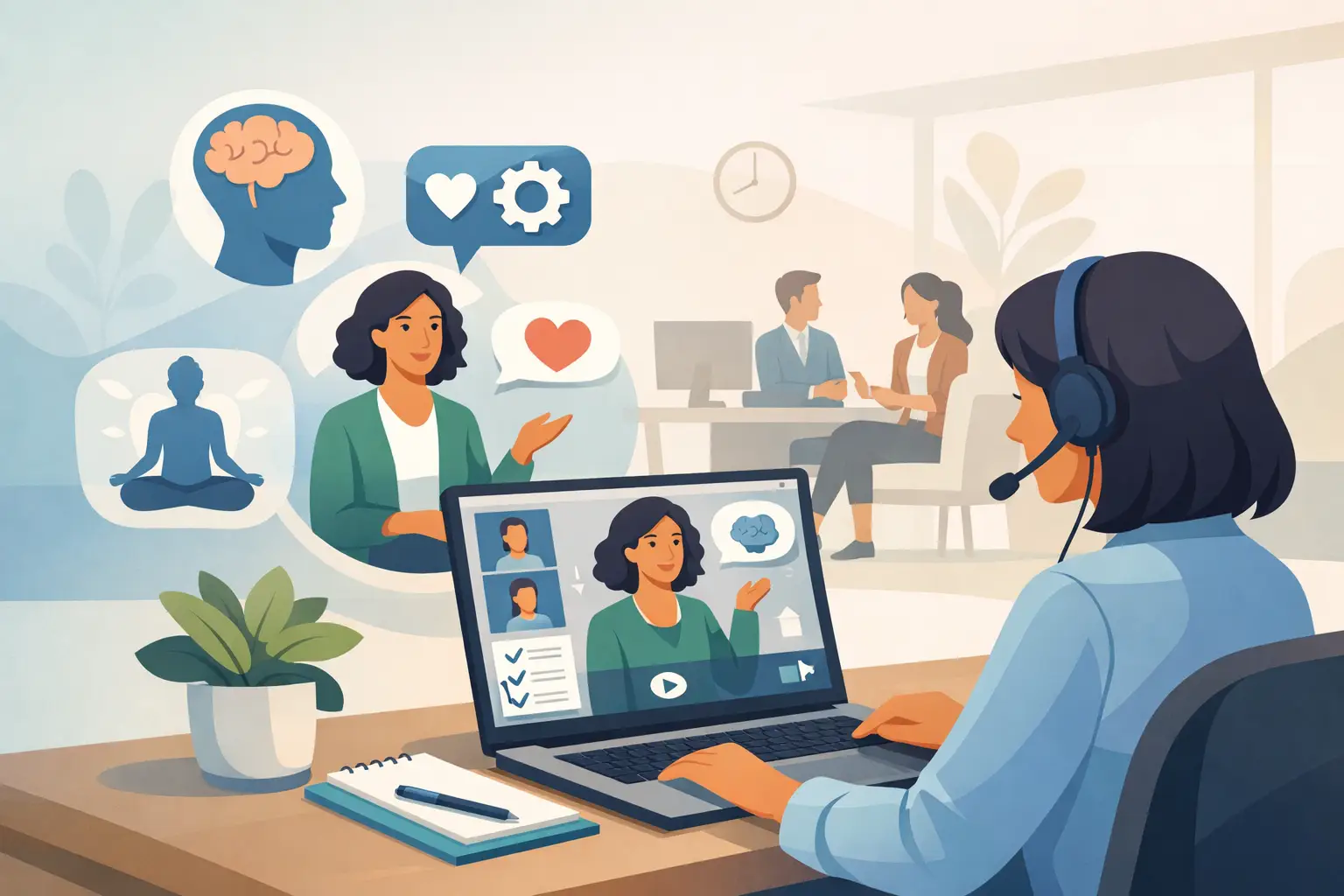
What good online mental health training workplace programs actually do
The strongest programs do more than explain mental health concepts. They build capability that managers and employees can use the same day. For leaders, that often means learning how to notice changes in behaviour, start a conversation early, respond without overstepping, document concerns appropriately and connect staff with internal or external supports. For employees, it may mean understanding stress responses, boundaries, help-seeking, peer support and everyday actions that strengthen resilience.
Crucially, good training is grounded in workplace reality. A frontline supervisor in logistics has different pressures from a people leader in professional services. A school leader, healthcare manager or government team director may face trauma exposure, operational fatigue or complex stakeholder demands. Generic content tends to miss these differences, and when training feels generic, engagement drops.
Effective programs also recognise that confidence is often the missing ingredient. Many managers know they should check in with staff. Fewer feel confident doing it well. Training should close that gap with scenarios, examples, practice and clear language. When leaders know what to say and what not to say, they are far more likely to act early.
The business case is stronger than many organisations realise
There is still a tendency in some workplaces to frame mental health training as a culture initiative rather than a performance initiative. That is a mistake. The most useful lens is capability and risk management.
When managers are not trained, warning signs are missed, conversations are delayed and issues become more complex and costly. When teams do not understand psychosocial risks, harmful patterns can become normalised. The result is not only distress for individuals but operational drag for the business.
By contrast, targeted training can support lower absenteeism, stronger retention, better manager effectiveness and a more consistent approach to psychological safety. It can also strengthen compliance efforts by showing that the organisation is taking a proactive approach to education, prevention and response. Training alone is not enough, but it is a visible and practical part of a broader psychosocial risk strategy.
For executives and HR leaders, the question is less whether training is worth it and more whether the current approach is producing measurable change. If completion rates are high but confidence, behaviour and incident trends are unchanged, the program is not doing its job.
Where online training works best, and where it needs support
Online delivery has clear advantages. It is scalable, efficient and easier to roll out across multiple sites. Staff can complete modules without travel, and new leaders can be onboarded quickly. Self-paced formats also help when schedules are tight or when teams operate across time zones.
But there are trade-offs. Sensitive topics can feel harder to explore in a fully self-paced environment, particularly for leaders who need to practise difficult conversations. Some organisations get the best results from blended delivery: online modules for core knowledge, supported by live workshops, manager masterclasses or facilitated debriefs that turn theory into action.
It also depends on the objective. If the goal is broad foundational literacy across a large workforce, online learning can be highly effective. If the goal is to shift how senior leaders handle psychosocial hazards, lead after critical incidents or manage complex performance and wellbeing conversations, more interactive support is usually needed.
This is where many organisations underinvest. They purchase access to content but not the implementation support required to translate learning into workplace behaviour.
How to choose online mental health training for the workplace
A strong provider should be able to explain exactly what business problem the training solves. That might be low manager confidence, inconsistent responses to mental health concerns, rising psychosocial risk exposure, or a need for scalable capability across a national workforce. If the answer is vague, the outcomes will be vague too.
Look closely at the learning design. Does it focus on awareness alone, or does it teach practical response skills? Does it reflect Australian workplace obligations and psychosocial hazard expectations? Is the content credible, current and delivered by qualified specialists who understand both mental health and leadership? These details matter because workplace mental health sits at the intersection of people, performance and risk.
Measurement matters as well. Good programs should track more than attendance. Pre and post confidence scores, knowledge application, manager behaviour change, employee feedback and risk indicators all tell a more useful story. Organisations serious about ROI need evidence that training is lifting capability, not simply ticking a box.
Customisation is another differentiator. Off-the-shelf content may be enough for basic awareness, but employers dealing with trauma exposure, aggressive customers, high workload intensity or major organisational change often need examples and tools tailored to their environment. Training lands better when people can see their own workplace in it.
What implementation looks like in practice
The most successful programs are treated as part of business operations, not a side campaign. Senior leaders sponsor the work. Managers are told why it matters. HR and WHS teams align the training with policies, reporting pathways and support services. Employees understand how the learning connects to day-to-day expectations.
Timing also matters. Rolling out training during a major restructure, peak operational period or crisis can reduce uptake unless communication is handled carefully. On the other hand, those moments often make the need more urgent. It depends on whether the organisation is ready to support managers as they apply what they learn.
A practical rollout often starts with leaders and managers, because they shape team climate and early intervention. From there, employee programs can reinforce shared language, resilience skills and help-seeking pathways. Some organisations also benefit from targeted modules for high-risk roles or executive briefings on psychosocial governance.
At Workplace Mental Health Institute, this is the difference between education that sounds good and training that changes outcomes. The organisations that get traction are the ones that treat mental health capability as a leadership and risk priority, not a once-a-year initiative.
Online mental health training workplace results to look for
The right outcomes are both human and commercial. You want managers who step into conversations earlier, not later. You want employees who understand support pathways and feel safer raising concerns. You want clearer responses to psychosocial hazards, fewer preventable escalations and stronger confidence across the organisation.
Not every result appears overnight. Culture shifts take time, and psychological safety is built through repeated action. But some indicators should move quickly, especially manager confidence, quality of conversations and engagement with support options. If nothing changes after training, the issue is usually not that mental health is too hard to influence. It is that the program was not practical enough, relevant enough or supported well enough.
The organisations doing this well are not chasing performative wellbeing. They are building workplaces where people can perform, recover, contribute and speak up without fear. That is good for compliance, good for culture and good for business.
The real opportunity is not simply to put training online. It is to build a workforce that knows how to respond well when pressure shows up at work, because it always does.