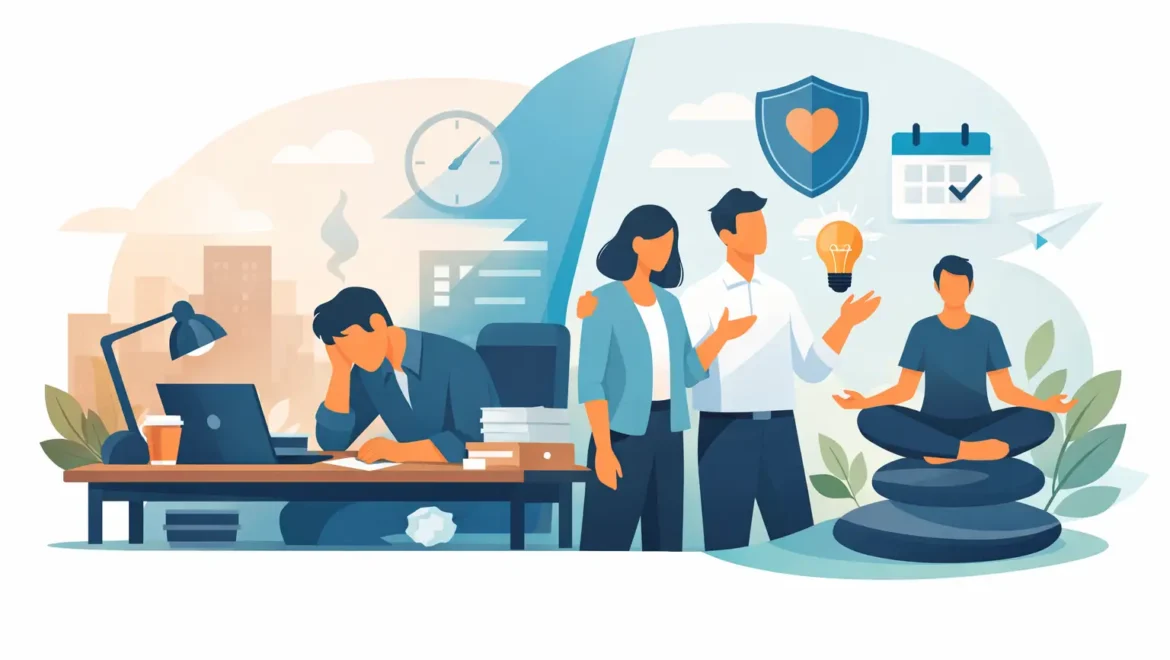
WorkLife eMag October-2018 Issue ft Bethenny Frankel
Bethenny Frankel featured in our WorkLife – Workplace Resilience eMag October 2018 issue, discussing mindfulness, perfectionism, mental health checklists and domestic violence.
Earlier this year, results from an Australian study of over 3,500 employees across 42 organisations from different industries found that one third of the participants were suffering from some form of mental disorder. Of those, 36% were suffering from depression, 33% from anxiety, and 31% from stress.
The results echo the statistics from other parts of the world. In the UK, the National Centre of Social Research reports that 26% of people have been diagnosed with a mental disorder, and a further 18% experience an undiagnosed mental disorder each year. The USA reports 20% – 32% of adults have a mental health condition each year, depending on the study. Research on prevalence in Canada and New Zealand show similar results.
Staggeringly, 58% of women and 73% of males who met the clinical criteria for depression or anxiety did not know they had a problem. Only 17% of participants in the clinical ranges for depression or anxiety were seeking help. 47% of employees do not feel comfortable discussing a mental health condition with their manager.
The implications for workplaces include increased absenteeism, presenteeism, disability claims, accidents, injuries and illnesses, grievances and complaints, turnover and legal implications.
Globally, mental health problems are estimated to cost workplaces 2.5 trillion US dollars, and that’s expected to rise to 5 trillion by 2030, according to the World Health Organization.
Everyone feels stressed from time to time. Stress is the biological and physical response to a perceived threat or danger and is often described as a feeling of being overwhelmed or worried. In modern day society, everyday stressors include managing work and family commitments, work deadlines, financial pressures and family issues. Stress can also be caused by sudden negative change, including loss of a loved one or job, or experiencing trauma, such as a major accident or natural disaster.
Not all stress is bad. Stress can be highly motivating at times and can enable us to perform in job interviews, work presentations etc. The majority of people are equipped with the ability to handle short lived periods of stress. However, prolonged periods of stress or excessive stress can lead to significant mental and physical health problems including depression and anxiety.
Everyday stress can be the toughest type of stress to tackle because the source of the problem tends to be more constant, and the body therefore stays in a state of alarm.
Something needs to be done to stop the tide.
Learn more about Stress…
A decade ago, one in five employees were living with a mental disorder in a given year and, according to the latest studies around the world, the statistics are worsening. There is still a stigma associated with mental health conditions, and approximately half the time, individuals do not seek help or even know they have a problem. In very real terms this means that management is often operating with half of the information they need to manage their employees.
To tackle this issue, it’s important for HR professionals to offer a wide range of wellbeing initiatives, as one size does not fit all.
Mindfulness based stress reduction training is evidence based education that has proven effective in reducing stress, anxiety and depression, and can be offered in conjunction with other organizational wellbeing initiatives, to improve staff productivity, performance and wellbeing.
According to PWC, organizations that are dedicated to creating a mentally healthy workplace, can expect a positive return on investment (ROI) of 2.3.
If you are interested in running our Mindfulness At Work course for your team, please contact us at admin@wmhi.com.au or give us a call.
Peter Diaz is the CEO of Workplace Mental Health Institute. He’s an author and accredited mental health social worker with senior management experience. Having recovered from his own experience of bipolar depression, Peter is passionate about assisting organisations to address workplace mental health issues in a compassionate yet results-focussed way. He’s also a Dad, Husband, Trekkie and Thinker.
In mindfulness workshops, most people raise their hand when asked if they have heard of the word before and are able to describe mindfulness as being more present and calm. So it’s safe to say, Mindfulness has become a widely familiar term.
While participants see the value in feeling less stressed and not getting caught up in thoughts about the past or worries about the future, they do not know where to start and crave practical tools and guidance on how to be more present and feel calmer. For those who have tried mindfulness meditation before, some have given up after feeling like they’re ‘not good’ at it.
Participants are surprised to learn that there is no right way of practicing mindfulness; it can be practiced at anytime, anywhere and in a number of different ways. Simply taking a few minutes before going to sleep, or on your commute home and focusing on your five senses, rather than scrolling through social media or responding to emails to exercise your brain, to support your mental health and wellbeing could be the small yet essential change that is needed to help prevent burning out.
Read more on mindfulness and wellbeing….
Mindfulness has been scientifically proven to improve memory, focus and concentration, improve our immune system functioning and sleep patterns, decrease ruminative thinking, increase self-awareness and our ability to regulate our emotions, empathise and see things from other people’s perspectives. Most importantly – it reduces stress. Practicing mindfulness deactivates the amygdala – (fight or flight response) responsible for stress, anxiety and fear and depression.
How? Through a process called neuroplasticity which is the brain’s ability to change and re-wire itself. Improvements can be seen in as little as a day however structural changes to the brain can be seen on imaging scans after only 8 weeks of practicing mindfulness.
Mindfulness is essentially brain training – the more we practice tuning into the present, the better we become. The more we practice emotional-regulation, the better we become. The more we practice taking a breath before reacting, the better we become.
All good reasons to train your employees to become more mindful, right? If you are interested in running our Mindfulness At Work course for your team, please contact us at admin@wmhi.com.au or give us a call.
Tania is an experienced Mindfulness Facilitator who has delivered training to organisations across Australia. Tania is also a Human Resources professional with almost 10 years experience working for medium to large corporate businesses across different industries in London and Sydney. Tania combines her a wealth of HR knowledge and experience implementing wellbeing initiatives, to support employee wellbeing, drive engagement, performance and productivity.
Mindfulness expert Jon Kabat-Zinn defines mindfulness as the “process of paying attention, on purpose, to the present moment, non-judgmentally”. But what does this actually mean?
Research from Harvard has shown that we spend almost half of our lives distracted, not living in the present moment, bemoaning the past or catastrophizing the future. We spend very little time living in the present moment.
Mindfulness is a powerful tool that can help people to slow down, and connect with the present moment. Mindfulness not only trains people to experience the world through our five senses and be more open to what life has to offer. Mindfulness also helps people develop greater self-awareness and an opportunity to reflect on their thoughts and feelings objectively. This helps to alter our habitual responses, by taking a pause and choosing how we react to a situation.
Read more on mindfulness and wellbeing….
Mindfulness training is evidence-based education that effectively reduces stress, anxiety and depression, and can be offered alongside other organizational leadership and wellbeing initiatives, to improve engagement, creativity, performance and wellbeing.
According to PWC, creating a mentally healthy workplace for your organisation with workshops of this type, can bring you a positive return on investment (ROI) of 2.3.
If you would like to know about our Mindfulness in the Workplace course for your team, please contact us at admin@wmhi.com.au or give us a call.
Tania is an experienced Mindfulness Facilitator who has delivered training to organisations across Australia. Tania is also a Human Resources professional with almost 10 years experience working for medium to large corporate businesses across different industries in London and Sydney. Tania combines her a wealth of HR knowledge and experience implementing wellbeing initiatives, to support employee wellbeing, drive engagement, performance and productivity.
This September issue of WorkLife is dedicated to the Future of Work. Yes, we’re assuming work has a future and we’ve dared to explore it.
This month’s feature is about a dog called Shirelle. Or at least it is in principle. The truth is that it is about a dear, wise, friend of mine, Doug Green. Doug is a psychotherapist who specializes in working with childhood issues. There is a lot that is special about Doug, but what is really unique to Doug, is his love of animals, and the way he incorporates them into his work.
So the story is about his dog Shirelle and what Shirelle taught him about life, love, loss, communication and healing. It’s about what Doug has done with that knowledge and how ‘Shirelle’ has gone on to change the lives of tens of thousands of kids and young people around the world, even after death. Read the entire story with other good articles in this August edition. All crafted to help people with their WorkLife.
Post Traumatic Stress Disorder is an Anxiety disorder that is triggered as a result of some serious trauma. The Diagnostic Statistic Manual version V states that “Post traumatic Stress Disorder is characterized by the re-experiencing of an extremely traumatic event accompanied by symptoms of increased arousal and by avoidance of stimuli associated with the trauma. (DSM-VI)”
In layman’s terms, this means that some people tend to re-experience the feelings of distress and horror from after having gone through some extreme negative event. This can be very disruptive to the person’s life and cause a high level of dysfunction. In the most extreme cases, people have resorted to suicide in a desperate attempt to obtain relief. The classic example of PTSD is that of the returned war veteran that has experienced severe trauma in the battlefield and keeps having flashbacks to being back in the battlefield.
Read more on stress in the workplace….
This is serious trauma. If you suspect you or a loved one maybe suffering from Post Traumatic Stress Disorder, I suggest you to talk to us or to another fully qualified mental health professional fast. In the meantime, make sure you provide appropriate first aid.
On the positive side, note that, while it is normal for people to have a reaction to a traumatic event, most people recover naturally with time, never get to experience PTSD and go on to lead trouble free lives. Yet in some individuals, these experiences do turn into trauma and could be diagnosed as having PTSD. There are good and valid reasons as to why this happens and the good news is that there are effective treatments that can help you recover.
Please, if you suspect you or a loved one maybe suffering from Post Traumatic Stress Disorder, I suggest you get help fast. If you would like to further your training, you might want to consider running the Mental Health Essentials course in your workplace where we deal with disorders in greater detail and we show you how to apply a first aid response to mental health emergencies at work. (read our blog – First Aid for Mental Health Problems – W.A.R.M.)
Peter Diaz is the CEO of Workplace Mental Health Institute. He’s an author and accredited mental health social worker with senior management experience. Having recovered from his own experience of bipolar depression, Peter is passionate about assisting organisations to address workplace mental health issues in a compassionate yet results-focussed way. He’s also a Dad, Husband, Trekkie and Thinker.
So you think someone you know maybe experiencing a mental health problem? Then the big question is ‘so what do I do? How do I respond now?
There’s no perfect thing that will always ‘work’ 100% of the time, because people are people, and we are all different, but there are definitely some clear principles, that are considered best practice when responding to someone who might be becoming unwell.
We’ve put together an acronym to help you remember the steps. And it’s called WARM.
It’s a reminder that as you do each of the actions in these steps, you are dealing with a person, a human, being, so be warm and friendly in your approach. Remember to use good body language and non-verbal communication that shows you really care. (If you are a manager, we encourage you to look into running a Workplace Mental Health Masterclass for Leaders in your workplace to make sure your team has the necessary skills. In the meantime, you might want to check the blog ‘How to Ask ‘R U OK?’)

Lets have a look at the WARM steps:
W stands for Watch – look for the signs and symptoms. Be observant.
It doesn’t mean that you have to be going about your day, nervously staring at everyone and looking for signs and symptoms. If you do that, you will start to think everyone has them! But it does mean to just be aware. If you see some things, and start to be concerned, don’t ignore it.
A stands for ASK – Approach the person directly. Ask them. This is the simplest, and best way to respond. By going directly to the person it avoids getting in a situation where you are talking about the person or making decisions about the person without having all the information and without them being involved. By going directly to the person, it can also help to minimise any fear or paranoia they may have bout office gossip.
So how do you ask then? (We deal with these topics more in detail in the Mental Health Essentials course)
We usually recommend, that if you are able to choose your timing, then before lunchtime tends to be a good idea. That means that after this conversation the person can have a bit of a break before they go back to work.
The conversation might not be a big in depth one, but we want to be prepared just in case it does bring things up for the person.
R stands for Refer – refer on to professional and other help. Here, it is important not to be too eager to jump in with ‘suggestions’ as to what the person should do. Remember, each person will have their own view of what is going on, and the action you think is best, may not resonate with them at all.
So again, questions are best. You can ask things like ‘have you seen anyone about this, or done anything to get some help with it?’. It is quiet possible that they are already getting some professional help.
Or you can ask them ‘what do you think we could do to get some advice with this?’. Notice the ‘we’ language, helps the person to feel like they are not all on their own with this. You’re in it together.
Or you can ask who or what has been helpful in the past? When the person identifies what they think will be useful, they are much more likely to follow through and actually seek help, than if you told them where to go.
Of course, if they really cant think of anything, then you might like to make a couple of suggestions. Make sure to give a few different options, from a few different filters. For example ‘have you thought about seeing a doctor, or a counselor, or even a life coach?’.
Your aim here is to make sure the person knows what options they have available to them, and if possible has agreed to take some steps to get help.
M stands for Monitor – Finally, the last step is Monitor. Check in with them over the next few days or weeks, and continue supporting them by being available to chat or to help with any practical assistance they may need. If they have said they will get some help, just check in and ask how it went. Keep these check-ins casual, and make sure you also talk with them about other, non mental health related things too. You don’t want all your conversations to be about mental health!
So that’s the WARM response. Easy to remember, and easy to do. As long as you follow those steps, you have gone a long way to assisting someone with a mental health problem.
It doesn’t necessarily mean they WILL get help, or that they WILL get better. But remember they are responsible for what they choose to do. You have done your part to help, and followed the best practice we have for responding to someone who may be experiencing a mental health problem. It also means that this person now knows they are not alone. This is very powerful.
If you are ready to get practical, real skills around this subject, our Mental Health Essentials course does just that over one day. Perfect for workplaces of any sort.
Peter Diaz is the CEO of Workplace Mental Health Institute. He’s an author and accredited mental health social worker with senior management experience. Having recovered from his own experience of bipolar depression, Peter is passionate about assisting organisations to address workplace mental health issues in a compassionate yet results-focussed way. He’s also a Dad, Husband, Trekkie and Thinker.
Often people feel a little awkward asking someone if they are OK, when they’re worried about them. One reason could be that they don’t want to interfere, but when it comes to mental health, we must ask, so people can get the help they need. Another reason, and it seems to be very common, is that we may not know what to say. After all, we want to get it right and not make things worse!
It’s a good idea to start with an ‘I’ statement. By saying ‘I’ve noticed’, or ‘I’m worried’, you are not making any statements directed towards the person. It is less likely to come across as blame or attack, and the person is less likely to be defensive.
Make sure that what you have noticed or the reason you are worried, is something that you have seen directly. You DO NOT want to involve someone else by saying ‘so and so told me that you did x’. That can just make the person feel worse or even become paranoid. If you haven’t seen anything directly yourself, it’s a good idea to make sure you have some opportunities to observe how the person is before you approach them.
You don’t need to sound like a psychologist. It’s annoying. Keep the language casual. This is not the time for jargon and technical language like ‘I’ve noticed you seem to have decreased appetite and lack motivation lately’. Instead you might say something simple and real like ‘I’ve noticed you haven’t really been eating much and seem a bit flat’.
Read more on workplace mental health….
So once you’ve led in with what you’ve noticed, you can follow it up by a general question to get the person talking. You can start with something like ‘Are you ok?’, ‘is everything ok?’, or ‘ is there anything I can do to help?’. Or just let them know that you wanted to see if they wanted to talk.
Of course, they may say ‘no no, everything’s fine’. That’s ok. You could gently ask a few more questions to see if they will open up. Like ‘are you sure?’, because you really haven’t seemed yourself lately’. But if they continue to say there’s nothing wrong, or they don’t want to talk about it, then that’s ok.
Many times though, the person will tell you a little bit of what is happening for them. And you want to make sure to give them plenty of time to let them talk, before you move on to the next step.
So again, questions are best. You can ask things like ‘have you seen anyone about this, or done anything to get some help with it?’. It is quiet possible that they are already getting some professional help.
Or you can ask them ‘what do you think we could do to get some advice with this?’. Notice the ‘we’ language, helps the person to feel like they are not all on their own with this. You’re in it together.
Or you can ask ‘who or what has been helpful in the past?’ When the person identifies what they think will be useful, they are much more likely to follow through and actually seek help, than if you told them where to go.
Just let them know that if there ever was anything, or if they did want to talk, that you’re available, or that there are other places they can go too, like a counselling service or a helpline.
Remember you are human too. Make sure you are safe, both physically and emotionally, and make sure to keep your resilience in check. Many organisations are calling us in to deliver resilience courses to their workforces because they have been proven to build resilience and increase protective factors.
We teach the above mental health communication skills and more in our Mental Health Essentials course. If you’d like to run one in your workplace or community, please contact us at admin@wmhi.com.au
Peter Diaz is the CEO of Workplace Mental Health Institute. He’s an author and accredited mental health social worker with senior management experience. Having recovered from his own experience of bipolar depression, Peter is passionate about assisting organisations to address workplace mental health issues in a compassionate yet results-focussed way. He’s also a Dad, Husband, Trekkie and Thinker.