
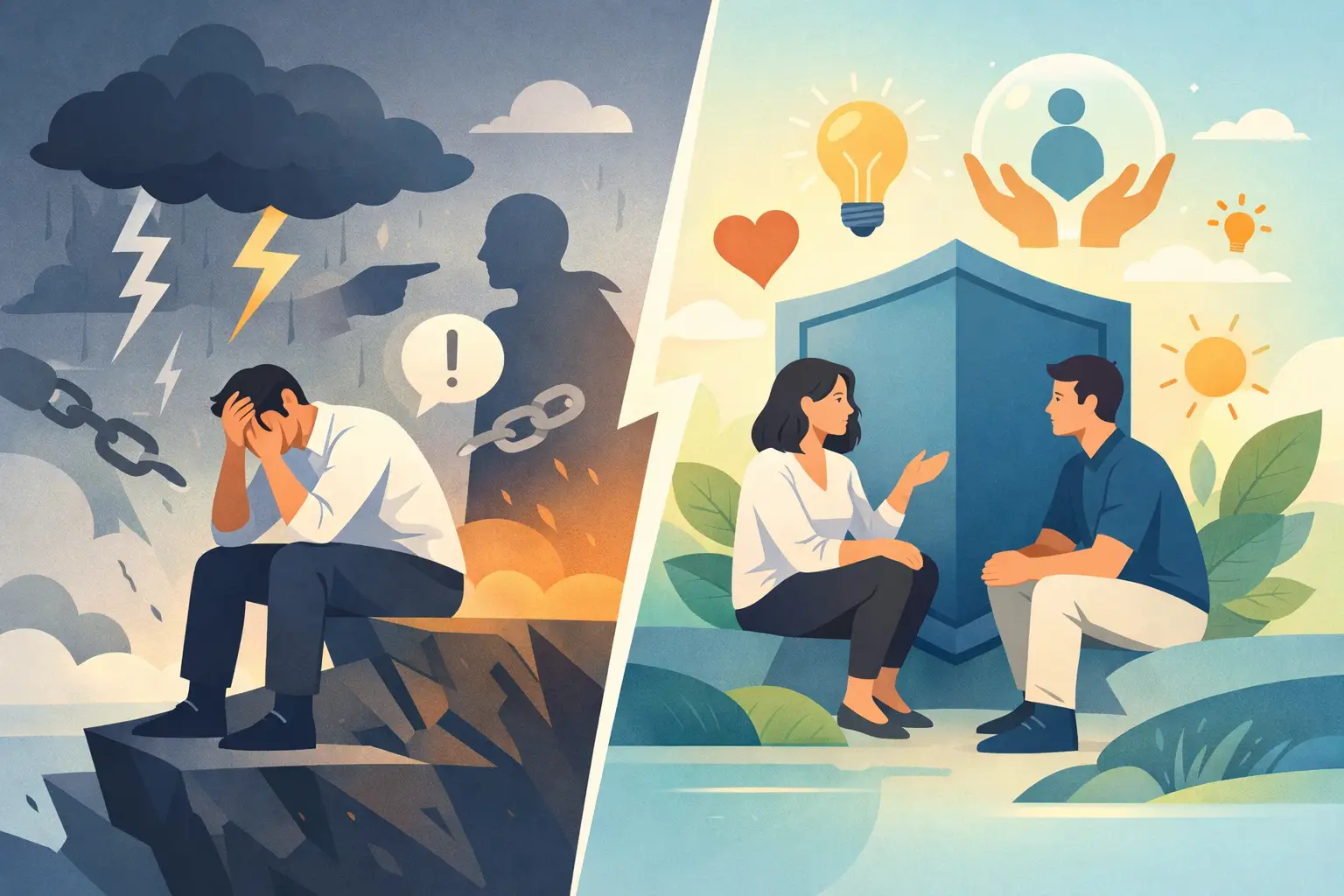
If your leadership team is still using psychosocial hazards and psychological safety as if they mean the same thing, you are likely creating risk with one hand while trying to improve culture with the other. The distinction between psychosocial hazards vs psychological safety matters because one sits squarely in your risk and compliance obligations, while the other reflects whether people feel safe to speak up, contribute and perform at their best.
For Australian employers, that difference is not academic. It affects how you assess WHS risk, how managers lead, how teams communicate and, ultimately, whether your workplace reduces harm or quietly amplifies it. Get the language wrong and the strategy often follows.
Psychosocial hazards vs psychological safety: what is the difference?
Psychosocial hazards are aspects of work design, management, environment or social interaction that can cause psychological harm. Think high job demands, low role clarity, poor support, bullying, exposure to traumatic content, low job control or conflict that is left to fester. These are hazards because they create a foreseeable risk of injury.
Psychological safety is different. It describes a team climate where people feel able to speak up, ask questions, admit mistakes, challenge ideas and raise concerns without fear of humiliation or punishment. It is about interpersonal conditions and group norms that support learning, contribution and trust.
The practical difference is simple. Psychosocial hazards are sources of risk that employers must identify and manage. Psychological safety is a performance and culture condition that helps people function effectively and speak openly, including about those risks.
That means a workplace can be legally exposed to psychosocial hazards even if leaders talk often about trust and openness. It also means a team might have low psychological safety without any obvious single hazard sitting on a register. The two concepts overlap, but they are not interchangeable.
Why the distinction matters for leaders
When organisations blur these terms, they often default to culture messaging when the issue actually requires risk controls. A leader might encourage staff to speak up, for example, while leaving unreasonable workloads, unclear reporting lines or unmanaged aggression untouched. That is not prevention. It is asking employees to be brave inside a system that is still causing harm.
The reverse can happen too. An organisation may complete a psychosocial risk assessment, produce a control plan and still struggle with silence, defensiveness and poor team learning. The hazards may be documented, but if employees do not feel safe to raise concerns early, many issues stay hidden until they become complaints, absences or claims.
Strong organisations work on both. They reduce hazard exposure through better systems, and they build psychological safety through better leadership behaviour.
Psychosocial hazards are a WHS issue first
In Australia, psychosocial hazards are part of work health and safety obligations. Employers are expected to identify hazards, assess risks, implement controls and review whether those controls are working. This is not a wellbeing extra. It belongs alongside any other serious workplace risk.
That matters for executives and boards because the cost of getting it wrong is not limited to compensation claims. Poorly managed psychosocial risk drives absenteeism, turnover, presenteeism, conflict, low productivity and leadership failure. In sectors with high emotional load or public scrutiny, the reputational cost can rise just as quickly.
A psychologically safe culture supports compliance, but it does not replace it. You cannot coach your way out of a hazardous job design. If workloads are unreasonable, if staff face repeated aggression, or if managers are creating chronic ambiguity, the answer is not a resilience poster or a town hall about speaking up. The answer is to change the work.
Common examples of psychosocial hazards
Most leaders recognise bullying and harassment, but many hazards are more ordinary and more widespread. Excessive workload, poor change management, inadequate reward and recognition, low autonomy, poor supervisor support and exposure to distressing material are common examples. Because they can feel normal in busy workplaces, they are often missed until the damage shows up in leave data, engagement surveys or injury reports.
This is one reason capability matters. Managers need enough training to spot risk patterns early, not just respond when someone is already unwell.
Psychological safety is a leadership and team capability
Psychological safety is built through day-to-day behaviour. It shows up in how managers respond to bad news, whether people are punished for speaking frankly, and whether mistakes are treated as learning opportunities or personal failures.
In high-performing teams, psychological safety does not mean lowering standards or avoiding difficult conversations. In fact, the opposite is usually true. Teams with strong psychological safety tend to handle challenge better because people can test ideas, flag risks and course-correct early. The environment supports candour, not comfort at any cost.
That is an important trade-off to understand. Some organisations mistake harmony for safety. If meetings are polite but people withhold concerns, that is not psychological safety. It is managed silence.
What psychological safety looks like at work
You can usually see it in small moments. A frontline manager says, “I may have missed something here – what do you think?” A team member raises a client risk without worrying they will be labelled difficult. A supervisor thanks someone for reporting a near miss instead of asking why they created extra work.
These behaviours improve more than culture. They improve decision quality, innovation, learning speed and risk visibility. That is why psychological safety is not just an HR concept. It is a business performance variable.
Where psychosocial hazards and psychological safety overlap
The two concepts influence each other. Poor psychological safety can increase psychosocial risk because employees may stay silent about harmful workloads, conflict, fatigue or unsafe behaviours. Strong psychological safety can improve early reporting and help control measures work in practice.
At the same time, unmanaged psychosocial hazards can erode psychological safety. If people are overworked, unsupported or exposed to repeated conflict, they are less likely to speak openly or trust leadership. Stress narrows capacity. People focus on self-protection.
So while the terms are different, they should sit in the same strategic conversation. One helps you prevent harm through risk management. The other helps you build the kind of leadership and team climate that surfaces problems before they escalate.
How to act on psychosocial hazards vs psychological safety
Start by separating your objectives. If you are addressing psychosocial hazards, your focus should be risk identification, assessment, controls and review. Use data such as claims, absenteeism, exit themes, grievance patterns, survey feedback and workload indicators to understand where the pressure points sit. Then change the conditions creating harm. That may involve job redesign, staffing changes, manager capability uplift, clearer role expectations or stronger systems for dealing with conflict and exposure to trauma.
If you are strengthening psychological safety, focus on leadership behaviour, team norms and communication habits. Managers need practical skill development in how to invite input, respond non-defensively, hold respectful challenge and manage mistakes without blame. Team rituals matter as well. Regular check-ins, clear decision rules and structured debriefs can all help, but only when leaders use them consistently.
For most organisations, the highest return comes from doing both in a coordinated way. A hazard assessment tells you where the risks are. Leadership training helps teams talk about those risks early and honestly. That is where measurable improvement starts to happen.
A common mistake: treating training as the whole answer
Training is essential, but it is not magic. If leaders attend a workshop on psychological safety and then return to impossible workloads, weak systems and mixed messages from senior executives, the effect will be limited. Behaviour change rarely survives in a poor operating environment.
The same applies to psychosocial compliance efforts that live only in policy documents. If risk controls are not visible in rostering, resourcing, supervision and change management, employees will see the gap immediately.
The strongest approach combines assessment, leadership development, practical controls and ongoing review. That is why many organisations now look for support that blends clinical credibility with operational understanding. Workplace Mental Health Institute, for example, works with employers to build both psychosocial risk capability and psychologically safe leadership in a way that can be applied on the ground, not just discussed in theory.
What good looks like
A mature organisation does not ask whether psychosocial hazards or psychological safety matters more. It knows each serves a different purpose. It treats psychosocial hazards as foreseeable workplace risks that require proper controls. It treats psychological safety as a leadership condition that improves speaking up, learning and performance.
That distinction helps boards ask better questions, helps HR and WHS teams align their efforts, and helps managers understand what is actually expected of them. Most importantly, it creates workplaces where people are less likely to be harmed and more likely to do their best work.
If your current strategy leans heavily toward awareness, this is the moment to get more precise. Reduce the hazards. Build the leadership behaviours. When both move together, culture improves for a reason, not by accident.