
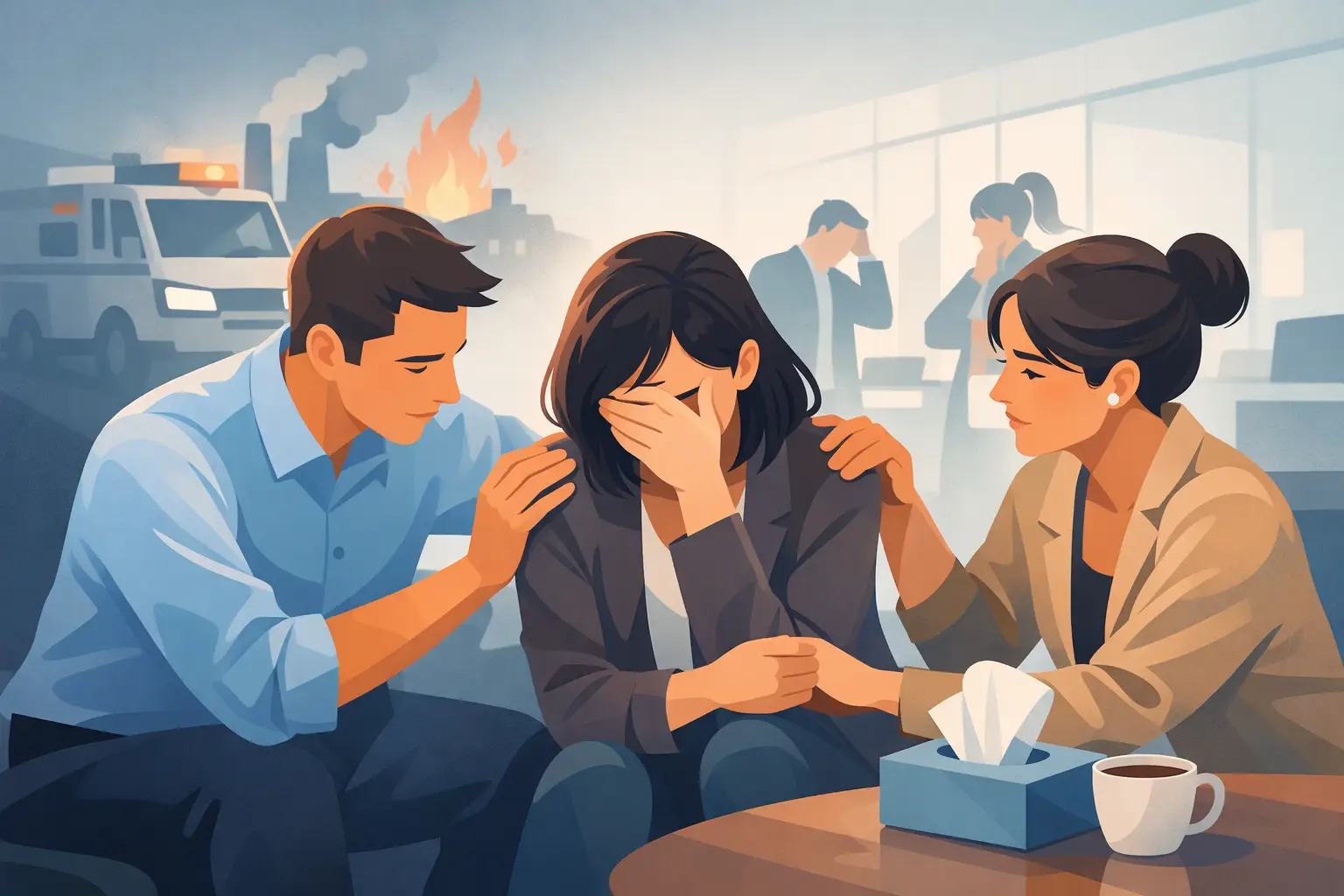
A serious injury, violent incident, death, threat, distressing disclosure or critical operational failure can change the emotional temperature of a workplace in minutes. Supporting staff after traumatic events is not a wellbeing extra for later in the week. It is an immediate leadership, psychosocial safety and business continuity responsibility.
The quality of an organisation’s response affects more than individual recovery. It influences whether people feel safe to return to work, whether managers can maintain trust, whether teams communicate clearly under pressure, and whether psychological injury risks escalate. A calm, capable response helps protect people while reducing disruption, absenteeism, turnover and avoidable claims.
The first priority is safety, not a polished message
Immediately after a traumatic event, people need practical certainty. They need to know whether the danger has ended, what is happening next, who is coordinating the response, and where they can access support. Leaders do not need to have every answer. They do need to avoid silence, speculation and mixed messages.
Start by addressing physical safety and operational needs. Confirm that emergency processes have been activated where required, ensure affected employees are not left alone if they are visibly distressed, and identify whether anyone needs urgent clinical or crisis support. Then establish one clear internal point of coordination, usually involving senior leadership, HR or people and culture, WHS and the relevant line manager.
Early communication should be factual, compassionate and proportionate. Share what employees need to know to stay safe and understand immediate workplace arrangements. Avoid graphic detail, assumptions about responsibility or promises that cannot be kept. Where an investigation is underway, say so plainly.
A useful message sounds like: we are aware of the incident, we are focused on the safety and wellbeing of those affected, work arrangements have changed in these ways, and support is available through these channels. Employees will often remember the tone and consistency of this communication long after they forget its exact wording.
Supporting staff after traumatic events requires different responses
Not everyone exposed to the same event will need the same level of support. The employee directly involved may need time away, practical assistance and ongoing contact. A colleague who witnessed the incident may be shaken but able to continue with adjusted duties. Others may be distressed because the event resembles a past experience, affects someone they know, or disrupts their sense of safety.
This is why a one-size-fits-all response can create risk. Mandatory group discussions that require people to recount the event or disclose feelings can be unhelpful, particularly in the first hours. Some employees benefit from talking; others need space, privacy and clear practical information. Managers should offer choice rather than pressure.
The most effective approach combines universal support for the broader team with targeted follow-up for people who were directly exposed or showing signs of difficulty. This protects privacy while ensuring that those at greater risk do not disappear into the background once the immediate crisis has passed.
What managers should look for
Managers are not expected to diagnose trauma. Their role is to notice changes, have respectful conversations and connect employees with the right support. Signs that a person may be struggling can include withdrawal, irritability, difficulty concentrating, unusually high absence, tearfulness, disrupted sleep reported at work, increased errors or a marked change in behaviour.
One sign alone does not prove a problem. Context matters. A capable manager asks rather than assumes: “I’ve noticed you seem under pressure since the incident. How are you managing at work today, and what would be helpful?” This opens the door without demanding a personal account.
Managers also need support themselves. They may be managing their own reaction while coordinating staff, customers, families, contractors or operational demands. Asking a frontline leader to carry this alone is a common and costly mistake. Provide them with clear decision rights, regular check-ins and access to an experienced adviser.
Stabilise work before pushing for normality
A rapid return to business as usual can send the wrong message. Equally, prolonged uncertainty can increase anxiety and reduce performance. The practical middle ground is to stabilise work through temporary adjustments that recognise the impact of the event.
Depending on the circumstances, this may mean changing rosters, reducing exposure to triggering tasks, reallocating customer-facing duties, postponing non-essential deadlines, offering flexible start and finish times, or providing a quieter workspace. For some teams, a short, structured briefing at the beginning of each shift will be more valuable than a broad wellbeing campaign.
These adjustments should be reviewed rather than left indefinitely. Agree on what will change, for how long, who will check in, and what a safe return to usual duties looks like. This gives employees predictability while helping the organisation manage operational capacity.
There is a trade-off to manage. Too little flexibility can make people feel unsupported and may worsen psychological risk. Too much, without a clear plan, can unintentionally isolate an employee or make returning to ordinary work feel harder. Individualised, time-bound adjustments are usually the strongest option.
Treat trauma as a psychosocial hazard
For Australian employers, traumatic events can create or heighten psychosocial hazards. Exposure to violence, traumatic material, bullying, aggression, serious incidents and high-consequence work may affect mental health, particularly when combined with poor supervision, excessive workload, role conflict or inadequate recovery time.
A supportive response therefore needs to extend beyond individual care. Leaders should examine the work conditions that may have contributed to the event or could intensify its impact. Questions worth asking include whether employees had adequate training, whether reporting systems were trusted, whether staffing levels were sufficient, and whether workers had meaningful control over how they performed difficult tasks.
This is not about assigning blame before facts are known. It is about meeting the organisation’s duty to identify hazards, assess risk and implement reasonable controls. It also produces better learning. If an incident exposes gaps in escalation processes, manager capability or communications, those issues should be fixed before the next crisis tests the organisation again.
Build a response plan before it is needed
The organisations that respond best are not necessarily those that never face difficult events. They are the ones that have prepared leaders, tested their processes and made psychological safety part of everyday management.
A practical trauma response plan should define who leads, how employees and families are communicated with, when external support is activated, how privacy is protected, and how leaders document actions without turning support conversations into surveillance. It should also include a follow-up process at key points, such as 24 to 72 hours, one week, and several weeks after the event.
Training matters because a written plan cannot make a manager confident in a difficult conversation. Leaders need to practise how to respond to distress, communicate boundaries, make appropriate adjustments and recognise when they need specialist guidance. They also need to understand what not to do: minimise the event, demand resilience, share private information, or assume that someone is fine because they have returned to work.
Workplace Mental Health Institute helps organisations build this capability through practical manager training, trauma-informed approaches and psychosocial risk strategies that translate policy into action when it matters most.
Measure recovery, not just attendance
An employee returning to work is not the same as an employee being fully supported. Attendance is one indicator, but it should sit alongside other measures: team turnover, absence patterns, employee feedback, incident reporting, workload data, psychological injury claims and manager confidence.
A short post-incident review can reveal whether support was timely, whether communications were effective, and whether affected teams felt safe raising concerns. Keep the review focused on learning, not fault-finding. People are more likely to report risks early when they believe the organisation will respond fairly.
Traumatic events cannot always be prevented. A workplace that responds with clarity, compassion and disciplined follow-through can prevent a difficult event from becoming a longer-term cultural and psychological injury. The standard to aim for is simple: when people face one of the hardest moments of their working lives, they should not have to wonder whether their employer will show up.