
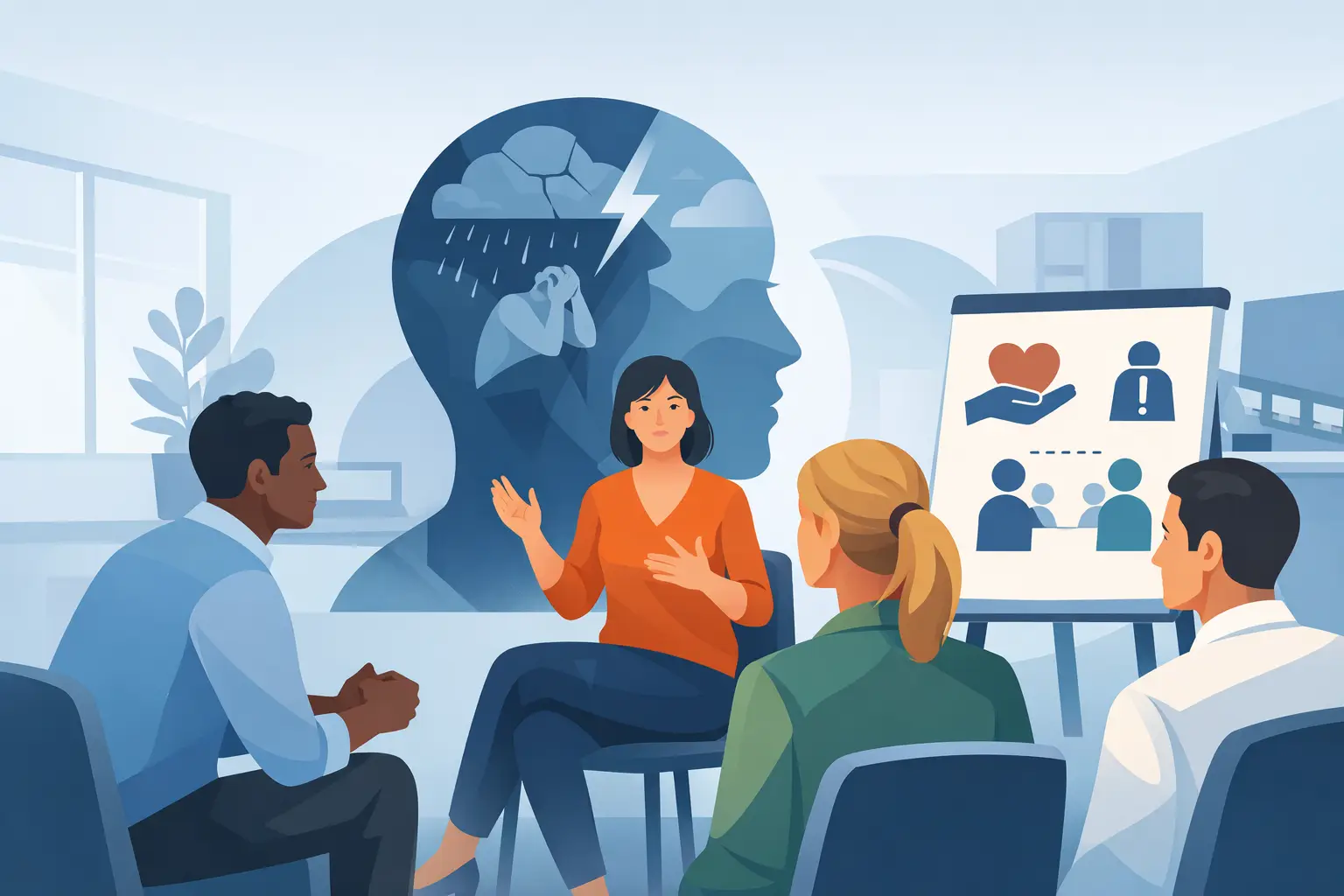
A distressed employee does not always say they are distressed. They may become unusually quiet, miss deadlines, react strongly to feedback, call in sick more often or disengage from colleagues. The question of who needs trauma informed training matters because a workplace response in that moment can either reduce harm or add to it.
Trauma-informed practice is not therapy, diagnosis or an expectation that managers become clinicians. It is a practical capability for recognising how trauma may affect behaviour, communication, trust and performance, then responding in ways that protect dignity, choice and psychological safety. For employers, it is also a risk-management and leadership issue. Poorly handled interactions can escalate conflict, increase absence and contribute to psychological injury claims. Skilled, consistent responses help people stay connected to work and support stronger team performance.
Who needs trauma informed training in a workplace?
The short answer is: any role that influences people’s experience of work, particularly during pressure, conflict, change or a critical incident. Not every employee needs the same depth of training. A board member does not need the same skills as a frontline supervisor responding to a worker after a violent incident. A tailored approach delivers better value, because it builds capability where exposure, decision-making authority and organisational risk are highest.
Executives and senior leaders
Senior leaders set the conditions in which trauma-informed practice either succeeds or becomes another well-intended poster campaign. Their role is to understand the organisational impact of trauma, including the risks created by excessive workloads, unsafe conduct, poor change management, harassment, customer aggression and inadequate post-incident support.
Leaders need enough knowledge to make sound decisions about policies, resourcing, escalation pathways and cultural expectations. They also need to model calm, respectful communication when difficult events occur. When executives treat psychological safety as a performance and governance priority, managers are more likely to act early rather than wait for a crisis.
For leadership teams, training should connect trauma-informed principles to psychosocial hazard management, legal duties, workforce retention and operational continuity. The goal is not simply empathy. It is better organisational judgement.
People and culture, HR and WHS professionals
HR, people and culture, wellbeing and WHS teams are often asked to manage the most complex situations: employee complaints, performance concerns, workplace conflict, return-to-work processes, serious incidents and organisational change. These professionals require deeper capability because their processes can have a major effect on whether an employee feels heard, safe and fairly treated.
Trauma-informed training helps these teams design processes that are clear, predictable and respectful. That includes explaining what will happen next, avoiding unnecessary repetition of a person’s story, offering reasonable choice where possible and maintaining appropriate confidentiality. It also helps practitioners balance care with procedural fairness. A trauma-informed approach does not mean avoiding difficult conversations or abandoning accountability. It means conducting those conversations without humiliation, coercion or avoidable distress.
WHS professionals also benefit from recognising that psychosocial risk controls must be practical. A policy alone will not protect workers if managers lack the confidence to respond appropriately after exposure to trauma, bullying, aggression or a critical event.
Managers, supervisors and team leaders
Managers are the priority group in most organisations. They have the greatest day-to-day influence on workload, communication, team climate and an employee’s willingness to seek support. They are also the people most likely to receive a disclosure, notice a change in behaviour or need to respond after a confronting event.
A manager does not need to know every detail of an employee’s history to lead well. In fact, asking for details can be intrusive and unnecessary. They need practical skills: how to check in without making assumptions, listen without trying to fix everything, set boundaries, offer options, document concerns appropriately and connect the employee with the right internal or external support.
Manager training is especially valuable in high-pressure environments where direct feedback, competing deadlines and operational disruptions are common. Without training, even capable leaders may interpret trauma responses as poor attitude, resistance or lack of commitment. That misread can damage trust quickly.
Frontline and customer-facing teams
Employees in customer-facing roles can be exposed to aggression, threats, grief, distressing disclosures or traumatic events. This includes teams in government services, healthcare-adjacent settings, education, community organisations, contact centres, transport, security and emergency response environments. It can also apply to retail, hospitality and field-based workers where customer behaviour is unpredictable.
These teams benefit from training that focuses on immediate, usable responses. They need to know how to de-escalate interaction, maintain their own safety, avoid taking responsibility for issues beyond their role and access support after an incident. The most effective programs include realistic scenarios drawn from the workplace, not generic theory.
Exposure is not always dramatic or isolated. Repeated contact with people in distress can have a cumulative effect. Training should therefore address both how employees respond to others and how they recognise when their own capacity is being affected.
Staff involved in investigations, complaints and performance processes
Investigators, employee relations advisers, grievance handlers and leaders conducting performance conversations need specialist trauma-informed skills. These processes can be necessary and fair, but they are often stressful for everyone involved. A poorly structured interview, unclear communication or an adversarial tone can compound distress and weaken confidence in the process.
Training for this group should cover informed communication, interview preparation, appropriate questioning, managing emotional responses and clear follow-up. It should also reinforce a crucial distinction: being trauma-informed does not predetermine the outcome of an investigation. Evidence, fairness and accountability still matter. The practice changes how the process is conducted, not the standard of proof or the obligation to address harmful behaviour.
Peer supporters and wellbeing champions
Peer supporters can play a valuable role, particularly in large or dispersed workforces where employees may be more comfortable speaking first with a trusted colleague. However, goodwill is not enough. Without boundaries and practical skills, peer supporters can become overextended, promise confidentiality they cannot maintain or feel responsible for solving situations beyond their capability.
Their training should be proportionate to the role. It should focus on listening, recognising limits, making safe referrals and protecting their own wellbeing. Peer support is a complement to strong leadership, HR processes and professional support pathways, not a substitute for them.
When should organisations prioritise trauma-informed capability?
Some organisations wait until a critical incident, a serious complaint or a rise in psychological injury claims prompts action. By then, trust may already be strained and leaders may be operating reactively. Training is more effective when it forms part of a preventative psychosocial safety strategy.
Priority is high where workers face violence, traumatic material, customer aggression, major restructures, high-conflict environments or repeated exposure to others’ distress. It is also valuable following a workplace death, serious injury, natural disaster, public incident or major organisational change. In these circumstances, people need more than a generic wellbeing message. They need leaders who can communicate clearly, make decisions calmly and create practical pathways for support.
That said, trauma-informed training is not only for traditionally high-risk sectors. Every organisation contains people with different life experiences, and work itself can be a source of harm when systems are unfair, unpredictable or disrespectful. A merger, sudden redundancy process or poorly managed complaint can affect employees profoundly, even when the organisation did not intend harm.
What good training should deliver
Awareness sessions can be a useful starting point, but capability is the commercial outcome. Training should give participants language and actions they can use in the next difficult conversation. It should be tailored to the workforce, role-specific and connected to existing incident, HR and wellbeing processes.
Look for programs that help participants understand common trauma responses without labelling people, practise psychologically safe communication, respond to disclosures within role boundaries and know when to escalate. Training should also address leadership behaviours that reduce risk at source, such as clearer expectations, manageable workloads, respectful feedback and better consultation during change.
Measurement matters. Organisations can assess manager confidence, employee perceptions of psychological safety, uptake of support pathways, absence patterns, incident reporting and psychological injury trends over time. No single measure proves success, and results depend on broader systems as well as training. But without a baseline and follow-through, it is difficult to know whether learning has changed workplace behaviour.
Workplace Mental Health Institute approaches trauma-informed training as a capability-building intervention: practical, role-relevant and aligned with the systems leaders use every day. The strongest results come when training is supported by clear policies, visible executive commitment and managers who have time to lead well.
The most useful question is not whether every person needs the same course. It is whether the people who shape your employees’ daily experience have the skills to respond safely when it counts. If the answer is uncertain, that is a clear place to begin.