Category Archives: Mental Health

How-Mindfulness-Can-Help-Reduce-Stress-In-The-Workplace

How Mindfulness Can Help Reduce Stress In The Workplace

In mindfulness workshops, most people raise their hand when asked if they have heard of the word before and are able to describe mindfulness as being more present and calm. So it’s safe to say, Mindfulness has become a widely familiar term.

While participants see the value in feeling less stressed and not getting caught up in thoughts about the past or worries about the future, they do not know where to start and crave practical tools and guidance on how to be more present and feel calmer. For those who have tried mindfulness meditation before, some have given up after feeling like they’re ‘not good’ at it.

Participants are surprised to learn that there is no right way of practicing mindfulness; it can be practiced at anytime, anywhere and in a number of different ways. Simply taking a few minutes before going to sleep, or on your commute home and focusing on your five senses, rather than scrolling through social media or responding to emails to exercise your brain, to support your mental health and wellbeing could be the small yet essential change that is needed to help prevent burning out.


Read more on mindfulness and wellbeing….


Don't forget to subscribe to our monthly eMag - WorkLife

Expert insights and tips on how to build resilient and mentally healthy workplace cultures delivered straight to your inbox each month.

Mindfulness has been scientifically proven to improve memory, focus and concentration, improve our immune system functioning and sleep patterns, decrease ruminative thinking, increase self-awareness and our ability to regulate our emotions, empathise and see things from other people’s perspectives. Most importantly – it reduces stress. Practicing mindfulness deactivates the amygdala – (fight or flight response) responsible for stress, anxiety and fear and depression.

How? Through a process called neuroplasticity which is the brain’s ability to change and re-wire itself. Improvements can be seen in as little as a day however structural changes to the brain can be seen on imaging scans after only 8 weeks of practicing mindfulness.

“Between stimulus and response there is a space. In that space is our power to choose our response. In our response lies our growth and our freedom”

– Viktor Frankl

Mindfulness is essentially brain training – the more we practice tuning into the present, the better we become. The more we practice emotional-regulation, the better we become. The more we practice taking a breath before reacting, the better we become.

All good reasons to train your employees to become more mindful, right? If you are interested in running our Mindfulness At Work course for your team, please contact us at admin@wmhi.com.au or give us a call.

Author: Tania Young
Tania Young

Tania is an experienced Mindfulness Facilitator who has delivered training to organisations across Australia. Tania is also a Human Resources professional with almost 10 years experience working for medium to large corporate businesses across different industries in London and Sydney. Tania combines her a wealth of HR knowledge and experience implementing wellbeing initiatives, to support employee wellbeing, drive engagement, performance and productivity.

What-is-Mindfulness

What Is Mindfulness

Mindfulness expert Jon Kabat-Zinn defines mindfulness as the “process of paying attention, on purpose, to the present moment, non-judgmentally”. But what does this actually mean?

Research from Harvard has shown that we spend almost half of our lives distracted, not living in the present moment, bemoaning the past or catastrophizing the future. We spend very little time living in the present moment.

Mindfulness is a powerful tool that can help people to slow down, and connect with the present moment. Mindfulness not only trains people to experience the world through our five senses and be more open to what life has to offer. Mindfulness also helps people develop greater self-awareness and an opportunity to reflect on their thoughts and feelings objectively. This helps to alter our habitual responses, by taking a pause and choosing how we react to a situation.


Read more on mindfulness and wellbeing….


Don't forget to subscribe to our monthly eMag - WorkLife

Expert insights and tips on how to build resilient and mentally healthy workplace cultures delivered straight to your inbox each month.

Mindfulness training is evidence-based education that effectively reduces stress, anxiety and depression, and can be offered alongside other organizational leadership and wellbeing initiatives, to improve engagement, creativity, performance and wellbeing.

According to PWC, creating a mentally healthy workplace for your organisation with workshops of this type, can bring you a positive return on investment (ROI) of 2.3.

If you would like to know about our Mindfulness in the Workplace course for your team, please contact us at admin@wmhi.com.au or give us a call.

Author: Tania Young
Tania Young

Tania is an experienced Mindfulness Facilitator who has delivered training to organisations across Australia. Tania is also a Human Resources professional with almost 10 years experience working for medium to large corporate businesses across different industries in London and Sydney. Tania combines her a wealth of HR knowledge and experience implementing wellbeing initiatives, to support employee wellbeing, drive engagement, performance and productivity.

Post-Traumatic-Stress-Disorder

Post Traumatic Stress Disorder

Post Traumatic Stress Disorder is an Anxiety disorder that is triggered as a result of some serious trauma. The Diagnostic Statistic Manual version V states that “Post traumatic Stress Disorder is characterized by the re-experiencing of an extremely traumatic event accompanied by symptoms of increased arousal and by avoidance of stimuli associated with the trauma. (DSM-VI)”

In layman’s terms, this means that some people tend to re-experience the feelings of distress and horror from after having gone through some extreme negative event. This can be very disruptive to the person’s life and cause a high level of dysfunction. In the most extreme cases, people have resorted to suicide in a desperate attempt to obtain relief. The classic example of PTSD is that of the returned war veteran that has experienced severe trauma in the battlefield and keeps having flashbacks to being back in the battlefield.


Read more on stress in the workplace….


Don't forget to subscribe to our monthly eMag - WorkLife

Expert insights and tips on how to build resilient and mentally healthy workplace cultures delivered straight to your inbox each month.

This is serious trauma. If you suspect you or a loved one maybe suffering from Post Traumatic Stress Disorder, I suggest you to talk to us or to another fully qualified mental health professional fast. In the meantime, make sure you provide appropriate first aid.

On the positive side, note that, while it is normal for people to have a reaction to a traumatic event, most people recover naturally with time, never get to experience PTSD and go on to lead trouble free lives. Yet in some individuals, these experiences do turn into trauma and could be diagnosed as having PTSD. There are good and valid reasons as to why this happens and the good news is that there are effective treatments that can help you recover.

Please, if you suspect you or a loved one maybe suffering from Post Traumatic Stress Disorder, I suggest you get help fast. If you would like to further your training, you might want to consider running the Mental Health Essentials course in your workplace where we deal with disorders in greater detail and we show you how to apply a first aid response to mental health emergencies at work. (read our blog – First Aid for Mental Health Problems – W.A.R.M.)

Author: Peter Diaz
Peter-Diaz-AuthorPeter Diaz is the CEO of Workplace Mental Health Institute. He’s an author and accredited mental health social worker with senior management experience. Having recovered from his own experience of bipolar depression, Peter is passionate about assisting organisations to address workplace mental health issues in a compassionate yet results-focussed way. He’s also a Dad, Husband, Trekkie and Thinker.

Connect with Peter Diaz on:
Peter Diaz on Face Book Peter Diaz on Twitter Peter Diaz on LinkedIn

WARM-First-Aid-for-Mental-Health

First Aid for Mental Health Problems – W.A.R.M.

So you think someone you know maybe experiencing a mental health problem? Then the big question is ‘so what do I do? How do I respond now?

There’s no perfect thing that will always ‘work’ 100% of the time, because people are people, and we are all different, but there are definitely some clear principles, that are considered best practice when responding to someone who might be becoming unwell.

We’ve put together an acronym to help you remember the steps. And it’s called WARM.

It’s a reminder that as you do each of the actions in these steps, you are dealing with a person, a human, being, so be warm and friendly in your approach. Remember to use good body language and non-verbal communication that shows you really care. (If you are a manager, we encourage you to look into running a Workplace Mental Health Masterclass for Leaders in your workplace to make sure your team has the necessary skills. In the meantime, you might want to check the blog ‘How to Ask ‘R U OK?’)

WARM-First Aid for Mental Health

Lets have a look at the WARM steps:

W stands for Watch – look for the signs and symptoms. Be observant.
It doesn’t mean that you have to be going about your day, nervously staring at everyone and looking for signs and symptoms. If you do that, you will start to think everyone has them! But it does mean to just be aware. If you see some things, and start to be concerned, don’t ignore it.

A stands for ASK – Approach the person directly. Ask them. This is the simplest, and best way to respond. By going directly to the person it avoids getting in a situation where you are talking about the person or making decisions about the person without having all the information and without them being involved. By going directly to the person, it can also help to minimise any fear or paranoia they may have bout office gossip.

So how do you ask then? (We deal with these topics more in detail in the Mental Health Essentials course)

Mental-Health-Essentials-banner

Don't forget to subscribe to our monthly eMag - WorkLife

Expert insights and tips on how to build resilient and mentally healthy workplace cultures delivered straight to your inbox each month.

We usually recommend, that if you are able to choose your timing, then before lunchtime tends to be a good idea. That means that after this conversation the person can have a bit of a break before they go back to work.

The conversation might not be a big in depth one, but we want to be prepared just in case it does bring things up for the person.

R stands for Refer – refer on to professional and other help. Here, it is important not to be too eager to jump in with ‘suggestions’ as to what the person should do. Remember, each person will have their own view of what is going on, and the action you think is best, may not resonate with them at all.

So again, questions are best. You can ask things like ‘have you seen anyone about this, or done anything to get some help with it?’. It is quiet possible that they are already getting some professional help.

Or you can ask them ‘what do you think we could do to get some advice with this?’. Notice the ‘we’ language, helps the person to feel like they are not all on their own with this. You’re in it together.

Or you can ask who or what has been helpful in the past? When the person identifies what they think will be useful, they are much more likely to follow through and actually seek help, than if you told them where to go.

Of course, if they really cant think of anything, then you might like to make a couple of suggestions. Make sure to give a few different options, from a few different filters. For example ‘have you thought about seeing a doctor, or a counselor, or even a life coach?’.

Your aim here is to make sure the person knows what options they have available to them, and if possible has agreed to take some steps to get help.

M stands for Monitor – Finally, the last step is Monitor. Check in with them over the next few days or weeks, and continue supporting them by being available to chat or to help with any practical assistance they may need. If they have said they will get some help, just check in and ask how it went. Keep these check-ins casual, and make sure you also talk with them about other, non mental health related things too. You don’t want all your conversations to be about mental health!

So that’s the WARM response. Easy to remember, and easy to do. As long as you follow those steps, you have gone a long way to assisting someone with a mental health problem.

It doesn’t necessarily mean they WILL get help, or that they WILL get better. But remember they are responsible for what they choose to do. You have done your part to help, and followed the best practice we have for responding to someone who may be experiencing a mental health problem. It also means that this person now knows they are not alone. This is very powerful.

If you are ready to get practical, real skills around this subject, our Mental Health Essentials course does just that over one day. Perfect for workplaces of any sort.

Author: Peter Diaz
Peter-Diaz-AuthorPeter Diaz is the CEO of Workplace Mental Health Institute. He’s an author and accredited mental health social worker with senior management experience. Having recovered from his own experience of bipolar depression, Peter is passionate about assisting organisations to address workplace mental health issues in a compassionate yet results-focussed way. He’s also a Dad, Husband, Trekkie and Thinker.

Connect with Peter Diaz on:
Peter Diaz on Face Book Peter Diaz on Twitter Peter Diaz on LinkedIn

Bullying-WMHI-blog-header

5 More Subtle Signs of Workplace Bullying

You may not think of your office as a place where bullying occurs, but believe it or not, this kind of interpersonal conflict happens in places other than just the schoolyard.

In fact,

research has shown that as many as 1 in 4 people report that they have experienced workplace bullying firsthand.

Unfortunately, workplace bullying often goes under the radar. Why? First of all, it’s not always as obvious as the overt name-calling, shoving, and teasing that we have come to associate with made-for-TV bullies. Secondly, bullying can be embarrassing: a team member who is being bullied may not want to talk about it for fear of looking weak. He or she may also feel pressure to avoid ‘dobbing in’ a coworker, or becoming the target of the bully if they step in on someone’s behalf.

But workplace bullying can and should be addressed by managers in any business or company. In the work environment, bullying tends to be a long, slow, and progressive process, whereby the perpetrator emotionally and psychologically manipulates his or her target over time. This can lead to serious problems with an overall workplace environment and may even contribute to lost productivity, increased errors, and other issues that are common with a distracted and unhappy team member (not to mention a worst-case scenario in which companies are held legally liable for failing to protect an employee against bullying).

Are you a psychologically safe manager? Take the self-assessment to find out.

WMHI Blog – 5 More Subtle Signs of Workplace Bullying

Read more on workplace bullying….


Don't forget to subscribe to our monthly eMag - WorkLife

Expert insights and tips on how to build resilient and mentally healthy workplace cultures delivered straight to your inbox each month.

So, the first step in putting an end to workplace bullying in your company is to learn how to tell if, when, and where it’s happening. Here are 5 subtle signals that your workplace environment may be home to some bullying:

  1. Frequent use of the blame game.

Is there a person on your team who seems to always have an excuse for his or her performance? Does he or she frequently point fingers at someone else, using another person as a scapegoat? Responsibility has to lie somewhere: if someone is unwilling to take personal responsibility for their own actions or inactions, then chances are they’re attempting to unfairly shift that responsibility to someone else.

  1. Minimising the thoughts, contributions, and feelings of others.

Having a patronising attitude toward someone is a subtle way of putting that person down and making him or her feel victimised. A team member who appears to make fun of, minimise, undermine, or discredit someone’s ideas or needs (especially on a consistent basis) could be bullying. They maylaugh derisively at someone’s thoughts or ideas; or physically disengage in communication by turning away and changing topic drastically.

  1. Deceit and dishonesty.

We all tell white lies from time to time. But if a person has a pattern of frequently lying, raising false hopes, or saying they’ll do something and then failing to follow through, then this could be a sign that he or she is trying to take advantage of the people around him or her.

  1. Intentional isolation by way of ignoring or excluding someone.

A sensation of “us versus them” can be seriously detrimental to the health and unity of a company. Team members may achieve this by purposefully not inviting someone to a work event or failing to include them in pertinent discussions, meetings, or projects. Purposefully underusing a team member or persistently delegating undesirable tasks to him or her (especially if they fall within many people’s job descriptions) can also be seen as an attempt for separation.

An example of this is, ‘ghosting’, where the bully will ignore a team member’s attempts to communicate for legitimate work reasons, while they acknowledge other people’s communication that they consider more important. While this practice is, unfortunately, widely tolerated in Australia, it is, nonetheless, damaging.

  1. Excessive flattery.

Going overboard on compliments and flattery is disingenuous at best; at worst itcan be a form of manipulation, persuading the target to check for the flatterer’s approval on any decisions or action. It can also be used as a prelude to more overt bullying, encouraging a person let their guard down, therefore becoming easier to manipulate.

The best bullies tend to be very smooth operators, able to hide their bullying well, and will leave just enough wiggle room to claim their good intentions are being misconstrued, in the event they’re called out. The best defense against bullies is education and awareness.  When people are aware of the signs, it becomes harder for the bully to operate freely.

Keep in mind that workplace bullying can happen at any level and in any direction within your company. Everyone, from senior level executives all the way to the newest team members should be held to the same standards that are necessary to create a positive and healthy work environment.

To your mental health,

– Peter Diaz

Author: Peter Diaz
Peter-Diaz-AuthorPeter Diaz is the CEO of Workplace Mental Health Institute. He’s an author and accredited mental health social worker with senior management experience. Having recovered from his own experience of bipolar depression, Peter is passionate about assisting organisations to address workplace mental health issues in a compassionate yet results-focussed way. He’s also a Dad, Husband, Trekkie and Thinker.

Connect with Peter Diaz on:
Peter Diaz on Face Book Peter Diaz on Twitter Peter Diaz on LinkedIn

RUOK-day-blog3

On R U OK Day: How Managers Can Make It Easier For Staff To Say, “I’m Not OK”

On R U OK? Day we’re reminded that leaders play an important role in safeguarding and supporting the mental health of their teams. Asking after the mental health of a team member is the first step, and a very important one, in creating a more mentally healthy workplace.

However, what we’ve noticed over the years in our training and consulting work, and what we’ve read in studies from the major world economies, is that employees are reluctant to open up about mental health concerns to their leaders.

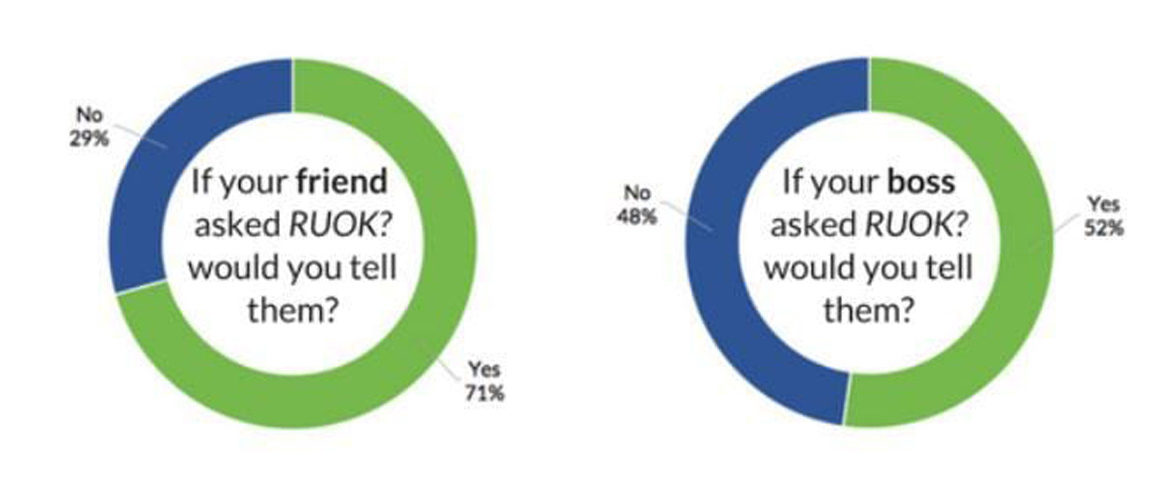
A study we completed recently confirmed what we’ve been hearing. We reached out to our community of managers and everyday employees and asked them two questions:

‘If a friend asked R U OK?, and the answer was ‘No’, would you tell them?’

‘If your BOSS asked R U OK?, and the answer was ‘No’, would you tell them?’

And, anticipating the response we might receive, we asked another question:

What advice would you give management to make it easier for their people to say ‘I’m not OK’?

We asked respondents to leave comments on the first two question if they wished, and we asked about their gender and age group so we could look for basic trends.

The results were pretty interesting.

Results


RUOK day blog image


Consistent with what we’ve seen and read, managers are a lot less trusted by employees when it comes to disclosing their mental health state. 29% of people said they’d hold back from telling a friend if they have a mental health concern. But that figure jumped to almost half when asked if they’d tell their manager.


RUOK day blog image

Gender differences

What did surprise us was that women were less likely to disclose than we expected, and actually less likely than men. Is it possible that women feel less secure in their employment than men, and feel a greater need to keep up appearances? This is an area we’ll be looking into with future research.

Age differences

We received low numbers of respondents under 35, so didn’t include them in age comparisons.

We noticed that males aged 35-44 were the least likely to disclose to friends or a boss. Perhaps with these years being the phase were men start to move into senior leadership and take on significant responsibility, that giving the appearance of ‘not handling it’ would be detrimental to their forward progress and so they stay quiet.

The other trend that stood out was respondents aged over 55. Again, it’s possible that older workers are concerned about job security, and perhaps it’s a generational thing: with older people in the main valuing their privacy and separation of personal life from professional life.


Read more on mental health and wellbeing…


Don't forget to subscribe to our monthly eMag - WorkLife

Expert insights and tips on how to build resilient and mentally healthy workplace cultures delivered straight to your inbox each month.

Comments

Would you tell a friend?

Of course, many people said it depends on who the friend is, citing things like:

  • How close they are
  • How easy they are to talk to
  • Whether they had the strength to deal with their reaction
  • Whether they were good listeners and would give their opinion
  • How supportive they are
  • If they thought they could help
  • If the friend has past troubles and perhaps could empathise

For many people, factors like timing, choosing the right setting and how bad things are, were also important.

Reasons they wouldn’t tell a friend included:

  • Not wanting to burden others, especially if they have their own struggles
  • Concern for privacy
  • Not wanting to be seen as a ‘whinger’ or ‘wimp’

But the news was not all bad. There were some strong arguments for telling a friend, a stand out one for us was, “I’ve learned the lesson of when you try to ignore it.” Seems like the message is getting through that asking for help is the best course of action.

Would you tell your boss?

Again, not surprisingly, most respondents said it depends on the person in the big chair.

  • I have faith or trust in my boss
  • It may help them to understand their situation too
  • I work in a supportive organisation
  • I’ve had good personal experience

…were all reasons people said they would and have told their boss.

But the news was not all good. Reasons given for not telling the boss ranged from concern about what might happen:

  • Stays on your record and impacts promotion opportunities
  • Don’t trust the boss
  • May be used against me
  • They may doubt my ability to do the job
  • Blurs boundaries – there are other options available
  • I work in mental health, we are expected to be ‘above that’
  • Fear about being performance managed
  • Don’t want to come across as not having it all together, weak or underperforming

To being once bitten, twice shy:

  • Had a bad past experience
  • Telling my boss complicated the situation
  • Boss avoids me now and I’m discounted
  • It was used to fire me

It’s clear a strong stigma remains around disclosing mental health concerns in the workplace. Alongside asking ‘RUOK?’ which is a noble and very important first step, we need to be giving managers better support. Specifically, we need to do two things:

  1. Help managers break down the stigma attached to mental health issues to create an environment where it’s ok to say, “I’m not OK”
  2. Give them the tools and training to respond and to help an employee who tells them they’re not OK. Sometimes a manager won’t ask because they don’t what to say if the answer is not ‘I’m fine, thanks for asking.’

In doing so, we’ll be creating confident, psychologically safe managers, capable of engaging teams to perform at their best.

Are you a psychologically safe manager? Take the test to find out.

Advice to managers

But don’t just take our word for it. Below we’ve listed verbatim all our respondents’ suggestions for how managers can make it easier for them to disclose a mental health issue without fear of repercussions.
  • Be genuine and authentic, care and empathy – all the time, too late when it comes to R U OK
  • Show interest in the whole person
  • Be available
  • Listen not problem solve
  • Talk about the subject at work, normalise it
  • Peer support group, EAP, resources
  • Discuss options without going down workcover route
  • More conversations
  • Culture of being your whole self at work
  • Open minded and honest
  • Confidential
  • Stress leave, reduced hours, duties, RDOs
  • Better education for managers
  • Let them know re good work too
  • Mental Health and Stress Management Policy
  • Safe that it’s not going to impact job
  • Suggestion boxes for anonymous feedback
  • Ensure privacy
  • Clear open policies promoted
  • Leadership skills for managers
  • Modelling from managers on how to deal with hard times, be vulnerable, take leave etc
  • Don’t doubt the answer when you get it
  • Do something – not just lip service to employee mental health
  • Ask more often not just once a year’
  • Be OK with uncomfortable
  • Treat worker as a human, not a number
  • Get others with a good experience to share it
  • Context – some want to be asked and to talk about it others won’t.
  • Recognise needs of carers (of people with mental illness, elderly, children etc)
  • Ask but also express that work need not be involved as long as performance ok
  • Managers need skills – don’t just pass it off to HR or EAP
  • Know how to follow up the question
On R U OK Day, and every day, let’s ask the question. But let’s go a step further and actualy equip our managers to create the productive and mentally wealthy work environments that we keep asking them for.

If you’d like to know how you can build the capability of your leaders in this space, consider inviting us to run a private Workplace Mental Health Masterclass for Leaders for your managers or team.

Author: Peter Diaz
Peter-Diaz-AuthorPeter Diaz is the CEO of Workplace Mental Health Institute. He’s an author and accredited mental health social worker with senior management experience. Having recovered from his own experience of bipolar depression, Peter is passionate about assisting organisations to address workplace mental health issues in a compassionate yet results-focussed way. He’s also a Dad, Husband, Trekkie and Thinker.

Connect with Peter Diaz on:
Peter Diaz on Face Book Peter Diaz on Twitter Peter Diaz on LinkedIn

3-ways-to-break-the-stigma-at-workplace

3 Ways To Break The Stigma Around Mental Health At Work

Mental health issues are a common problem facing Australians, and the related statistics are telling:

  • Currently, about 450 million people around the world are living with some kind of mental disorder.
  • According to the World Health Organisation, about 25% of the global population will experience a mental disorder at least once in their lifetime.
  • In Australia alone, about 1 out of every 5 of us will experience mental ill-health every year.
  • Mental health problems hold the dubious honor of being the third leading cause of disability within the Australian labour force.
  • It’s been estimated that Australian businesses lose more than $6.5 billion every year by not providing early intervention and treatment for their employees who are experiencing mental health issues.
  • However, despite evidence showing just how common this condition is, it’s been estimated that up to two thirds of people with a known mental health condition choose not to seek professional help.

Why is this so?

Access to care, language barriers, and a dearth of quality resources are a few reasons why, but perhaps the most insidious reason is stigma.

Mental Health Stigma Exists — and it Doesn’t Necessarily Stop at the Workplace

Stigma has a powerful influence in the world of mental health issues. Society at large often views people living with mental disorders as unstable, dangerous, or even violent. People with mental health challenges are often believed to be incapable of leading productive and fulfilling lives—indeed, sufferers themselves may even believe this. Research doesn’t tend to support these assumptions, but media and cultural expectations often bolster them, anyway.

These assumptions—real or imagined—can discourage people living with mental ill-health to seek much needed treatment. Their condition may make them feel ashamed, weak, and alone, which of course only compounds their mental health issue and propagates a vicious feed-forward cycle of stress, isolation, and illness.


Read more on mental illness and recovery…


Don't forget to subscribe to our monthly eMag - WorkLife

Expert insights and tips on how to build resilient and mentally healthy workplace cultures delivered straight to your inbox each month.

Mental Health Issues on the Job

If we agree that stigma about mental health is virtually ubiquitous, then it becomes clear how this same stigma can exist in the workplace, too. Specifically, both employers and employees may assume a mental health problem will render a person less productive, less organized, and less able to focus on their tasks at hand. Of course, in some cases this can actually hold true, especially if an individual hasn’t sought treatment for their underlying disorder.

Many workplace team members living with a mental health issue choose to hide their issues. They often fear for their job security or are afraid to risk “losing face” in front of their bosses, colleagues, and customers. On their end, employers may not have the tools and tactics to talk to their employees about their suffering. Indeed, an employer may not even be aware that one of his or her team members is suffering from a mental health issue in the first place (unlike a broken ankle or other physical ailment, mental health conditions are often “invisible” and difficult to recognise).

Are you a psychologically safe manager? Take the self assessment to find out.

It’s worth pausing here to reflect on something: mental health problems are common problems. It’s unfortunate that so many people grappling with anxiety, depression, post-traumatic stress disorder, and other issues believe that they have to face their challenges alone. Fortunately, leaders in business organisations are in a unique position to change the way their individual companies approach and accommodate mental health, which can have a profoundly positive impact on the issue of mental health as a whole.

3 Ways to Reduce Stigma Associated with Workplace Mental Health Issues

A workplace culture that stigmatises against workplace mental health issues can be detrimental to both individuals within a company and to the company as a whole. Breaking through this stigma can be extremely difficult. Here are 3 ways to get started:

  1. Educate at all levels.

From senior executives to entry-level team members, everyone in your company can benefit from learning more about mental health. Consider sending out company-wide memos, holding in-services, inviting guest speakers, or even running annual events such as “Mental Health Month” as a way to disseminate information and reduce the fear, stigma, and mystery surrounding mental health.

  1. Ensure everyone on your team has access to help.

Work with your HR team or consultants to raise awareness about policies and programs designed to support both physical and mental health. Use discretion and show that you respect your employees’ privacy.

  1. Make your anti-discrimination policies clear.

As a manager, it’s in your best interest to show your employees that they will not be discriminated against due to a mental health issue. Lead by example. Show that by acknowledging and seeking help for a health issue, a person can become an even more valuable employee at your company, rather than a liability.

To your mental health,

– Peter Diaz

Author: Peter Diaz
Peter-Diaz-AuthorPeter Diaz is the CEO of Workplace Mental Health Institute. He’s an author and accredited mental health social worker with senior management experience. Having recovered from his own experience of bipolar depression, Peter is passionate about assisting organisations to address workplace mental health issues in a compassionate yet results-focussed way. He’s also a Dad, Husband, Trekkie and Thinker.

Connect with Peter Diaz on:
Peter Diaz on Face Book Peter Diaz on Twitter Peter Diaz on LinkedIn

Psychological-Injury-at-Workplace

What Most People Don’t Know About Psychological Injury at Work

Traditionally, when speaking of Workplace Health and Safety, psychological injury is not something we thought about. But, as many professionals have realized lately, a Workplace Health and Safety strategy is severely incomplete without taking psychological injury into account. (for help creating a Mental Health Workplace Strategy visit www.wmhi.com.au) Psychological injury is also known as psychiatric injury, and it includes all mental, emotional and physical injuries acquired from the place of employment. Employees that suffer from a psychological injury due to an employer’s negligence can take legal steps against their employers, so it is essential to create a safe working environment to prevent such occurrences. Legally, it’s no longer ok to ignore the psychological safety of employees. Managers are now liable.

Yet, how do we know if an employee is at risk of psychological injury at work? One symptom of employees that are suffering from psychological injuries is a noticeable and measurable reduction in their production or in the way they handle, or their inability to handle, emotional issues. For example, they may become acutely defensive even when feedback given in a reasonable manner. Unfortunately, many businesses refuse to recognize that a place of business can have a severe psychological impact on its employees. However, considering that employees in full-time employment spend a significant portion of their time at work,it is clear that a workplace plays a vital role in an employee’s life. As well as their psychological state.


Read more on psychological injury at work and recovery…


Don't forget to subscribe to our monthly eMag - WorkLife

Expert insights and tips on how to build resilient and mentally healthy workplace cultures delivered straight to your inbox each month.

Traditionally, psychological injury was thought to be brought about by stressors in the workplace such as extremely high workloads, difficult employees, unrealistic deadlines or unrewarding work. Under this assumption, it was thought that a combination of stressors in a place of business increased the risk of psychological injury significantly. However, according to recent studies, other crucial factors can affect or cause mental injury at work. According to these studies, relationships at work and the level of support given to employeesis more likely to cause psychological injuries than anything else. In this regard, the less supported, the less valued and the less understood an employee feels at work, the greater the risk of a psychological injury.

This not only indicates that a change of attitude and behavior is required from employers;it also emphasizes the need to establish interpersonal relationships with employees. A positive relationship between employers and their employees creates a platform to handle conflicts well, which reduces the number of psychological injury claims made by employees. Additionally, through positive work relationships, collaborative behavior is encouraged, which promotes the establishment of considerations that can regulate the number of psychological injury cases that may arise.

A business that supports its employees through flexible arrangements makes employees feel valued, which encourages productivity in the personal and business lives of employees. To reduce conflict brought about by psychological injuries, it is essential for employers to create a safe work environment that is free of discriminatory practices and one that fosters positive work relationships between employees of all levels. By instituting training, campaigns and prevention strategies, employees can become more engaged, happier and less inclined to take legal action.

It takes effort, from both the employers and their employees to reduce the instances of injury. But, ultimately, it’s the employers responsibility to take the initiative to create a psychologically safe environment at work.

We help management create psychologically safe environments, and minimise psychological injury, with our many programs. In particular, our flagship course the Workplace Mental Health Masterclass for Leaders. Check it out and see if it can help you too.

Author: Peter Diaz
Peter-Diaz-AuthorPeter Diaz is the CEO of Workplace Mental Health Institute. He’s an author and accredited mental health social worker with senior management experience. Having recovered from his own experience of bipolar depression, Peter is passionate about assisting organisations to address workplace mental health issues in a compassionate yet results-focussed way. He’s also a Dad, Husband, Trekkie and Thinker.

Connect with Peter Diaz on:
Peter Diaz on Face Book Peter Diaz on Twitter Peter Diaz on LinkedIn

Mental-Health-and-Productivity

Mental Health and Productivity. Why Managers Need Mental Health Courses

Workplace Mental health is an issue of grave concern. In fact, it is one of the leading causes of absenteeism from work. Mental health problems at work can cause immense suffering to those experiencing them, and those around them. As such, there is an overwhelming need for managers, business owners and employees to address the issue of mental health at work. Managers particularly should play a significant role in promoting mental health among employees. However, it is essential that managers receive the right support to assist them to handle this task efficiently. If we are to empower supervisors and staff to make a positive impact on mental health it will involve giving them the proper training from industry experts and professionals through mental health courses.

A course on mental health would create awareness and understanding among managers, as well as teach them important lessons such as how to categorise common mental health disorders. Besides learning how to classify the signs and symptoms of mental suffering, they would also be counseled on practical strategies that can support members of their organisation.

The major benefits of taking a mental health course include:

  1. Gaining the ability to understand and appreciate the stigma surrounding mental health at work.
  2. Giving employees the confidence to handle clients or workmates suffering from mental health conditions in a humane manner.
  3. Awarding employees and business owners the opportunity to understand the legal requirements surrounding workplace mental health care.
  4. Teaching people techniques and strategies for managing employees with mental conditions.
  5. Improving one’s understanding of stress and how it impacts morale at work.
  6. Reflecting on our own attitude towards mental health problems. If the attitude is a negative one, then we can take measures to change and improve.
  7. Allowing participants to learn possible interventions for workplace mental illnesses.

Read more on workplace mental health strategies…


Don't forget to subscribe to our monthly eMag - WorkLife

Expert insights and tips on how to build resilient and mentally healthy workplace cultures delivered straight to your inbox each month.

The outcome of a good mental health training course should be to help management and their employees create a work environment where personal resilience is enhanced, and the comfort and safety of all employees is protected. This will enable the workforce to respond effectively to the challenges that arise while working, which in turn will enhance their confidence, allowing them to produce their very best.

Organisations often lose out on the expertise of capable workers due to mismanagement. Knowing what to do and how to manage the mental health of teams can be tricky. For most people suffering from mental health conditions, their last resort is often, sadly, a choice between a decline of their mental health or abandoning their jobs. Employers have a duty of care to their employees and investing in a course in mental health is the best way to secure the mental health of a workforce. The training should be practical and applicable so that the psychological safety and wellbeing of the whole organisation and its employees is enhanced. Good workplace mental health is good business and at the Workplace Mental Health Institute we want to help.

Author: Peter Diaz
Peter-Diaz-AuthorPeter Diaz is the CEO of Workplace Mental Health Institute. He’s an author and accredited mental health social worker with senior management experience. Having recovered from his own experience of bipolar depression, Peter is passionate about assisting organisations to address workplace mental health issues in a compassionate yet results-focussed way. He’s also a Dad, Husband, Trekkie and Thinker.

Connect with Peter Diaz on:
Peter Diaz on Face Book Peter Diaz on Twitter Peter Diaz on LinkedIn